Buying equipment outright may be less suitable when the practice expects its needs or technology to change. A veterinary equipment lease-versus-buy analysis should compare total costs over the expected period of use, including financing, maintenance, residual value and the risk of needing an upgrade. Leasing may suit equipment likely to be replaced sooner; buying may make more sense when long-term use and resale value support ownership.
It’s reasonable to focus on the upfront commitment. But the lowest initial outlay doesn’t necessarily mean the lowest total cost, and ownership brings responsibilities that a lease may handle differently. The decision depends on how the equipment fits your clinical workload, cash flow and technology plans.
This guide explains how to compare lease payments with purchase and financing costs, account for maintenance and end-of-term value, and weigh obsolescence against ownership. You’ll finish with a practical decision guide for choosing the option that fits your veterinary practice in Poland.
Key Takeaways
- Match the financing term to how long the equipment will remain clinically useful, not just to the size of the monthly payment.
- Build maintenance, repair responsibilities, and estimated resale value into the ownership calculation to see the fuller cost picture.
- Compare lease conditions with the flexibility ownership provides, especially when technology may need replacing before financing ends.
- Use your equipment needs and practice cash flow to decide whether buying, leasing, or combining both approaches fits best.
Assessing equipment needs and comparing finance options
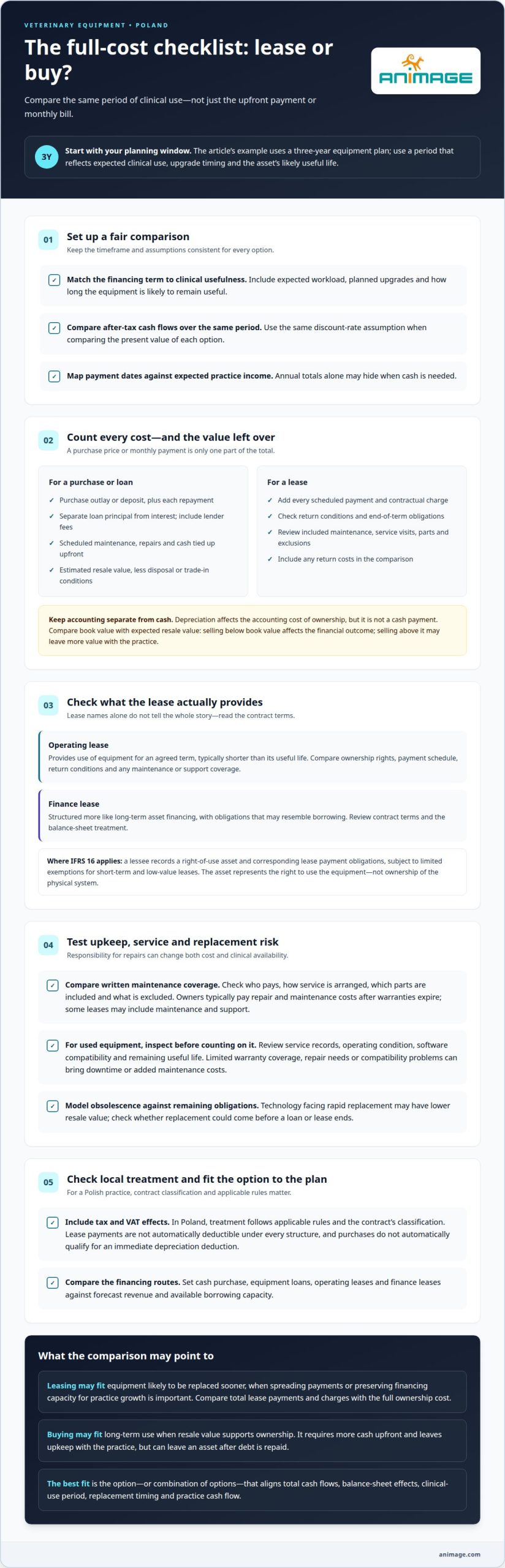
Start with expected clinical use, upgrade timing, cash flow and the asset’s likely useful life. Compare total payments and end-of-term obligations, not just the monthly cost.
Operating Leases and Finance Leases
An operating lease gives you use of equipment for an agreed term, typically shorter than its useful life. A finance lease is structured more like long-term asset financing, with obligations that may resemble borrowing. For a Polish practice, compare ownership rights, return conditions, payment schedules and how each contract affects reported assets and expenses.
Finance Leases and Right-of-Use Assets
Where IFRS 16 applies, a lessee records a right-of-use asset and corresponding lease payment obligations on its balance sheet, subject to limited exemptions for short-term and low-value leases. The asset represents the right to use the equipment, not ownership of the physical system. This accounting treatment differs from judging a lease solely by its cash payments.
Lease-versus-Buy Financial Results
Compare after-tax cash flows across the same period. Include initial payments, financing costs, depreciation, maintenance, residual value, and any return costs. One example uses an annual loan interest rate of 6%, but its result depends on its assumptions. Leasing can preserve financing capacity for practice growth; buying can leave an asset after the debt is repaid.
| Option | Initial cash demand | Asset position | Upgrade flexibility |
|---|---|---|---|
| Operating lease | Spread payments | Use during term | Review return terms |
| Finance lease | Spread payments | Right-of-use accounting may apply | Review contract terms |
| Purchase with loan | Deposit and repayments | Practice owns equipment | Practice controls replacement |
Financing Options for Veterinary Clinics
Compare cash purchase, equipment loans, operating leases and finance leases against forecast revenue and available borrowing capacity. In Poland, tax and VAT treatment follows applicable rules and the contract’s classification, so include those effects in your comparison. Lease payments are not automatically deductible under every structure, and equipment purchases do not automatically qualify for an immediate depreciation deduction. Match the financing term to expected use and planned upgrades.
Choose the option whose total cash flows, balance-sheet effect and replacement timing fit the practice’s operating plan.
Maintenance and residual value in ownership costs
For a three-year equipment plan, calculate ownership costs beyond the purchase payment. Add scheduled maintenance, repairs, financing interest, lender fees and the cash tied up upfront. Then subtract the equipment’s estimated resale value at the end of the period. This gives you a more useful comparison than purchase price alone. A machine with a strong resale market may retain value; a technology-heavy system facing rapid replacement may not.
Use the same worksheet for each option. Record the upfront deposit or purchase outlay, every scheduled payment and the timing of expected maintenance. For a loan, separate principal from interest and include lender fees in the total. These charges affect the practice’s actual cash flow, even when they don’t appear in the equipment’s depreciation schedule. Compare the present value of both options over the same period, using the same discount-rate assumption.
Depreciation affects the accounting cost of ownership, but it isn’t a cash payment. Track it separately from repair bills and loan repayments. At the end of the analysis, compare the equipment’s book value with its expected resale value. If the asset sells for less than its book value, the difference affects the financial outcome; if it sells for more, ownership may retain more value. Don’t count resale proceeds without accounting for disposal or trade-in conditions.
- Preserve capital: Leasing can reduce the initial cash commitment and spread payments, leaving more funds available for staffing, supplies, or practice growth.
- Measure long-term cost: Add every lease payment and contractual charge, then compare that total with ownership costs after maintenance and residual value.
- Test cash flow: Map payment dates against expected practice income, not just annual totals.
Leasing may cost more over a longer holding period, while buying requires more cash upfront and leaves the practice responsible for upkeep. For equipment likely to become obsolete, estimate how replacement timing affects resale value and any remaining loan obligations. The stronger choice is the one that fits the clinical-use period and preserves enough capital for planned operations.
Maintenance responsibilities under leasing and ownership
Buying used veterinary equipment in Poland can expose a practice to repair needs, limited warranty coverage or compatibility problems. Before including it in a clinical workflow, review its service records, operating condition, software compatibility and remaining useful life. A low purchase cost does not eliminate the risk of downtime or expensive maintenance.
In Poland, warranty, servicing, insurance and end-of-lease responsibilities depend on the contract. Compare warranty duration and exclusions, who arranges servicing, which insurance obligations apply, and whether the equipment must be returned, maintained or restored at lease end. A lease may include maintenance, but that doesn’t mean every repair or service cost is covered.
Leasing can reduce initial capital outlay and may make replacement easier when imaging technology becomes outdated. The trade-off is contractual: early termination penalties, usage limitations, mandatory maintenance and return conditions can restrict flexibility. Buying gives the practice ownership, but leaves it responsible for post-warranty repair costs and eventual resale or disposal.
Equipment with a short upgrade cycle may suit leasing when predictable replacement matters more than retaining the asset. Durable equipment used consistently over a longer period may suit purchasing, especially when the practice can manage upkeep. Assess each system separately; a single financing approach need not fit every device in the clinic.
A veterinary loan is an alternative to leasing. It funds an outright purchase, giving the practice ownership while repayments are made. Compare the loan’s payment schedule and interest with lease obligations, then account for maintenance, depreciation and future resale. This structure can suit clinics that want control over service and replacement timing, but the owner remains responsible for upkeep after the warranty expires.
Choosing equipment to buy or lease
Choose by expected replacement timing, not by monthly payment alone. For each system, map its clinical role, expected workload, upgrade path, maintenance needs, and useful life. Then compare that timeline with the financing agreement. Veterinary equipment leases commonly run 12 to 60 months, so a contract extending beyond the planned technology cycle can leave the practice paying for equipment it no longer wants to use.
Use this decision sequence for each purchase:
- Define the need: Identify which diagnostic workflow the equipment must support and whether that workload is expected to grow.
- Set the replacement point: Estimate when an upgrade could become clinically or operationally necessary.
- Compare total commitments: Include payments, maintenance responsibilities, return conditions, financing charges, and expected resale value.
- Stress-test cash flow: Check whether scheduled payments remain manageable if utilization grows more slowly than forecast.
Leasing can suit technology with a short upgrade cycle. It can preserve flexibility, but the agreement may restrict early termination, use, servicing or equipment returns. Buying may suit a durable system expected to remain in service after financing ends. Ownership gives the practice more control, but the clinic carries repair costs and resale risk. Neither option automatically wins on total cost.
A hybrid plan can separate these decisions. Purchase durable assets that support stable workflows; consider leasing technology-heavy equipment that may need frequent updates. For example, a clinic could own equipment with a long service horizon while leasing a system tied to a changing imaging workflow. This avoids treating every asset as if it has the same replacement schedule.
For a final comparison, write down the expected use period and replacement trigger beside each option. If a lease term outlasts the upgrade plan, prioritize flexibility and review exit conditions. If the equipment is likely to remain useful beyond repayment, ownership may better fit. To assess how imaging systems fit your clinic’s workflow, review veterinary imaging platform options.
Animage: FIDEX+
Animage’s FIDEX+ is a veterinary imaging platform for practices comparing ownership costs with clinical capabilities. It combines cone-beam CT, digital radiography and fluoroscopy in a single system. This makes it relevant when a clinic is assessing whether an integrated imaging system fits its diagnostic workflows and equipment plans.
Before deciding to purchase, map the system’s imaging modalities to current and anticipated case needs, available space, expected use and upgrade priorities. Then include it in the same total-cost comparison as other equipment: financing, maintenance responsibilities, useful life and potential residual value. FIDEX+ is purpose-built for animals and is offered to veterinary clinics, referral hospitals and research institutions.
If FIDEX+ fits your imaging requirements, contact Animage to discuss the platform.
Turn the Comparison Into a Procurement Decision
Before committing, turn the analysis into a brief decision record. State the clinical requirement, expected replacement point, acceptable payment structure and conditions that would trigger an upgrade. This gives clinical and financial decision-makers shared criteria, rather than leaving the choice to the most attractive monthly figure.
A veterinary equipment lease-versus-buy analysis is most useful when it supports a specific purchasing decision. Apply the same criteria to each system under consideration, then document your assumptions about expected use and replacement timing. That record can guide future equipment planning as the practice’s services and workload develop.
If imaging equipment is part of that decision, compare your workflow requirements with FIDEX+ and identify the questions that matter to your practice. Discuss your equipment options with Animage as you plan the next step. A clear decision framework helps your clinic move forward with purpose.
Frequently Asked Questions
What If Equipment Becomes Obsolete Before It's Paid Off?
If imaging equipment becomes outdated before financing ends, compare the cost of keeping it with the cost of replacing it. For a lease, read the agreement for early-exit charges, upgrade options and return obligations. For a purchase loan, calculate the outstanding balance and likely resale proceeds. A replacement plan should account for both the new system’s payments and any remaining commitment on the old one.
What does it mean to lease capital assets?
Leasing a capital asset gives a business the contractual right to use equipment for operations while making scheduled payments. Unlike a purchase, it doesn’t automatically make the practice the equipment’s owner. The agreement defines who retains title, what happens at expiry, and whether purchase or return options apply. These capital asset principles are equally vital across industrial and plant engineering sectors—such as those served by gpegroup.com.au—where long useful lives heavily favour ownership over short-term leasing. For a clinic, the key distinction is the rights and obligations set out in the contract.
What are typical veterinary equipment leasing rates, fees, and terms in Poland?
Polish veterinary equipment leasing has no single rate or fee that applies to every clinic. Payments depend on equipment value, term, initial contribution, credit assessment and any end-of-term option. Compare the total payable in zł, including each fee stated in the offer, with buying through cash or a loan. Check payment frequency, currency and whether payments can change over time.
How do leasing and buying compare on total cost over the equipment's useful life?
A veterinary equipment lease-versus-buy analysis should compare equivalent use periods and cash-flow dates. For buying, total the purchase outlay or loan payments, interest, fees and maintenance, then account for disposal proceeds. For leasing, total scheduled payments, included services, additional charges and return costs. Discount future cash flows consistently, then compare net present costs. If the lease ends sooner, include replacement costs for the remaining years.
What are the risks of leasing veterinary equipment, including maintenance, obsolescence, and early termination?
Leasing risks include early-termination penalties, equipment-use limits, required maintenance and return-condition costs. Obsolescence creates another exposure: the clinic may need an upgrade while contractual payments continue. Before signing, compare expected clinical life with agreement duration, identify who handles service and insurance, and record the return standard. These checks reveal obligations that a headline monthly payment can hide.
How should a veterinary clinic calculate the break-even point for leasing versus buying equipment?
Calculate break-even by comparing the cumulative discounted costs of each option over the same use period. Include purchase or lease payments, financing charges, maintenance, applicable tax effects and end-of-term value. The break-even point is where both options’ net present costs are equal. Repeat the calculation using an earlier replacement date and lower resale proceeds; either change can affect which option costs less.