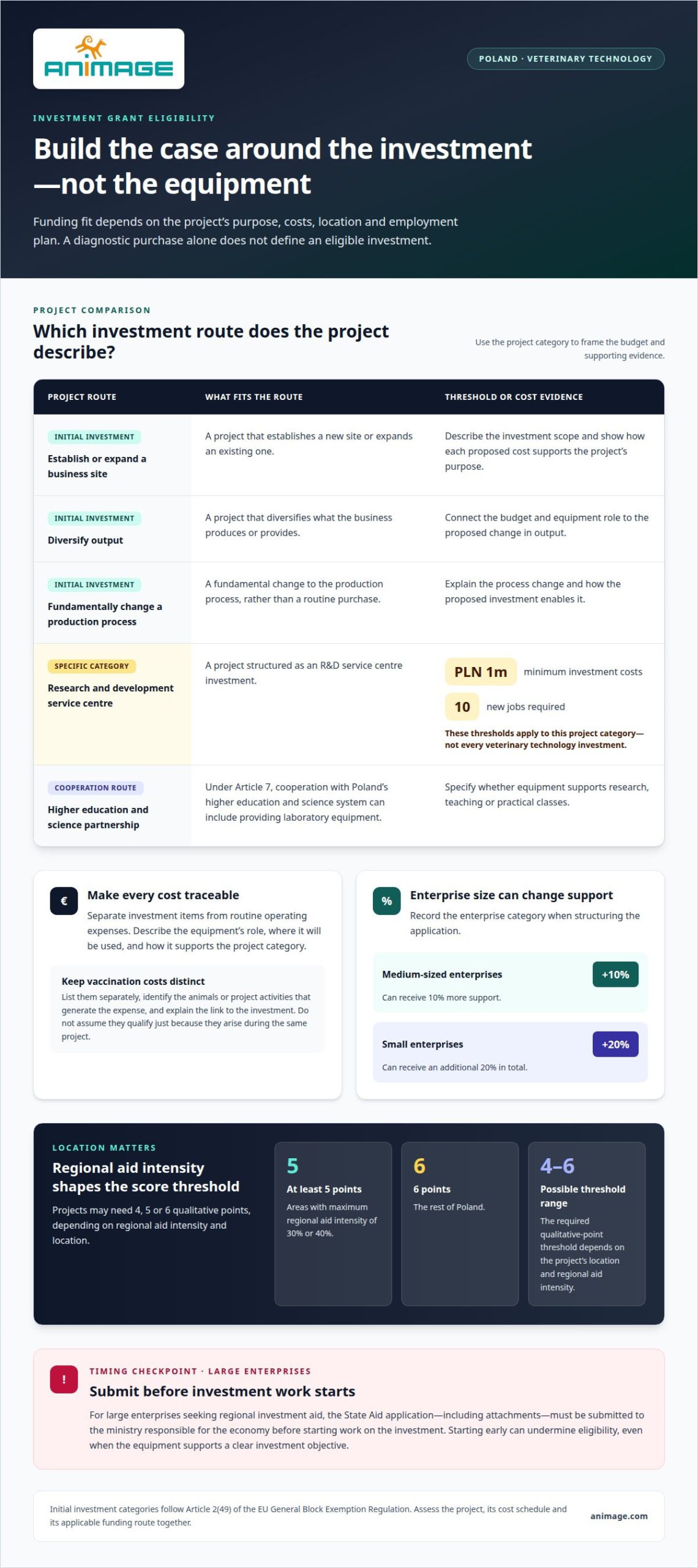
Government grants for veterinary technology in Poland depend on the investment project, not simply on buying new equipment. An initial investment can involve setting up or expanding an establishment, diversifying its output, or fundamentally changing its production process. For a research and development service centre project, the threshold is PLN 1 million in investment costs and 10 new jobs.
When considering government grants for veterinary technology in Poland, equipment cost is only one part of the decision. Eligibility can also depend on the project’s purpose, location, and employment plan. This guide outlines how to assess whether an investment may fit a Polish support programme, how to organise proposed costs, and why large enterprises must establish incentive effect before starting work. Treat diagnostic equipment as part of a defined investment plan, not as an automatically eligible purchase.
Key Takeaways
- Assess the full investment plan, not just the equipment purchase, to see whether the project fits an eligible investment category.
- Use the project’s location and regional aid intensity to identify the qualitative-point threshold that applies.
- Plan the application sequence carefully: for large enterprises, submitting the state aid application is a prerequisite to starting investment work.
- Compare available support routes against your project’s purpose, eligible costs and employment plan before settling on a funding strategy.
Investment grant thresholds and eligible costs
An initial investment is a project that establishes or expands a business site, diversifies its output, or fundamentally changes its production process. These categories follow Article 2(49) of the EU General Block Exemption Regulation and help distinguish investment projects from routine purchases.
A research and development service centre project has a minimum investment cost of PLN 1 million and must create at least 10 new jobs. Those thresholds apply to this project category. They are not a universal minimum for every veterinary technology investment, so first identify the project type.
Eligibility depends on the applicant and the specific funding route, not just on being a startup, clinic, farm, university, or nonprofit. A veterinary clinic or startup should define the investment purpose and project structure. Universities and research partners may fit a cooperation route: under Article 7, cooperation with Poland’s higher education and science system can include providing laboratory equipment for research, teaching, or practical classes.
Eligible costs are expenses assessed within a qualifying investment project. Build a budget that links each proposed cost to the project’s purpose, such as expanding diagnostic capacity or changing a research workflow. Separate investment items from routine operating expenses. Describe the equipment’s role, where it will be used, and how it supports the project category. This makes the connection between the budget and the investment clear.
List vaccination costs separately from diagnostic technology. Identify the animals or project activities that generate the expense and explain its relationship to the proposed investment. Do not assume vaccination costs qualify simply because they arise during the same project. Eligibility depends on the programme’s rules and the documented link to the investment.
Enterprise size can affect regional support: medium-sized enterprises can receive 10% more support, while small enterprises can receive an additional 20% in total. Record the enterprise category when structuring the application. Then match the project scope, job plan, and cost schedule to the relevant support route.
Application procedure and incentive effect
An incentive effect means aid changes the applicant’s decision to undertake an investment. For large enterprises seeking regional investment aid, Article 6 of Commission Regulation (EU) No 651/2014 sets the incentive-effect requirement.
Timing is critical. A large enterprise must submit its State Aid application, including attachments, to the ministry responsible for the economy before starting work on the investment. Define the project scope, prepare the required materials, and submit them before work begins. Starting early can undermine eligibility, even if the equipment supports a clear investment objective.
For regional investment aid, the application must also address the applicant’s recent activity history. A beneficiary that closed the same or a similar activity in the European Economic Area during the two years before applying cannot receive this aid. Compare the proposed activity with the applicant’s operations across the EEA, not just at its Polish site.
Reporting, procurement, State Aid documentation, and repayment obligations are set out in the applicable funding call and grant agreement. Follow the agreement’s reporting schedule, purchasing procedures, evidence requirements, and repayment clauses. Keep invoices and records that link each expense to the approved project.
Common rejection risks include an incomplete application, costs that do not fit the project, and starting investment work before the required submission. Before applying, align the application, cost schedule, project description, and timing. For example, if a clinic proposes to expand diagnostic capacity, its budget and implementation plan should support that same scope.
Use this sequence to prepare a coherent application:
- Define the investment and its regional-aid category.
- Confirm the project timeline and required submission point.
- Match every proposed cost to the project description.
- Prepare attachments and submit before investment work starts, where required.
- Track the grant agreement’s reporting and procurement obligations.
For a large enterprise, submitting the application before work begins is a practical eligibility requirement, not a minor administrative detail. Even a well-documented project needs the correct sequence and a clear incentive rationale.
Government assistance and financial aid
Support routes differ by project purpose and location. For veterinary technology, separate investment aid from research, education, and regional funding.
Polish and EU Funding Programs
A funding program is a defined route that supports projects meeting its purpose and eligibility rules. Poland’s investment support program runs from 2011 to 2030, while regional aid intensity and location affect the qualitative score required. Projects may need 4, 5, or 6 points; areas with maximum regional aid intensity of 30% or 40% require at least 5, and the rest of Poland requires 6. For veterinary research infrastructure, the National Recovery and Resilience Plan co-financed modernization at the National Veterinary Research Institute in Puławy.
Grant-Administering Institutions
A grant-administering institution manages a funding call and its application process. Applicants may encounter PARP, NCBR, and ARiMR when assessing Polish support routes, but the relevant call’s scope determines whether a veterinary technology project fits. For example, the National Veterinary Research Institute’s facility modernization received co-financing from Poland’s National Recovery and Resilience Plan. Cooperation with higher education and science institutions can also include laboratory equipment for research, teaching, or practical classes under Article 7.
Regional and Local Grants
Regional and local grants are support routes whose conditions reflect a project’s location. Poland’s investment program differentiates qualitative thresholds by regional aid intensity, so identify the project’s location before estimating its route. An area at risk of exclusion includes counties or cities with county status where unemployment is at least 160% of the national average. A city at risk of exclusion is identified by a list in Table 3 of Annex 1 to a Council of Ministers regulation dated 27 December 2022. These location criteria can affect the support assessment for a clinic or diagnostic investment. They do not, by themselves, establish that every local call covers veterinary equipment. Check each call’s purpose, applicant criteria, and eligible project costs against the planned investment before preparing an application.
Which Polish and EU funding programs support veterinary clinics, diagnostic equipment, or animal-health technology?
A funding route is a programme whose objectives and rules determine which projects may receive support. In Poland, investment aid and research funding serve different project types. Match the proposed activity to the programme before preparing an application.
Poland’s investment support programme may be relevant when veterinary technology forms part of a qualifying business investment. EU regional investment aid follows the General Block Exemption Regulation, while Poland’s programme also uses location-based and qualitative criteria. A clinic planning to acquire diagnostic equipment should explain how the purchase fits the wider project, rather than treating the equipment as a standalone grant category.
Research projects can follow a separate route. The National Veterinary Research Institute in Puławy received PLN 1,562,920 through OPUS 29 for research into PFAS contamination of food during cooking. This example concerns research, not a general equipment grant for veterinary clinics. It illustrates why applicants should distinguish scientific work from commercial investment before selecting a funding call.
Some sectors are excluded from Poland’s program under Article 13, including iron and steel, coal, shipbuilding, synthetic fibres, transport, and energy. Veterinary technology applicants should define their actual activity and project scope clearly. The sector label alone does not explain whether a project fits; the investment’s purpose and the call’s terms matter.
Use this screening sequence before preparing a proposal:
- Classify the project as business investment, research, or institutional cooperation.
- Match the project purpose to the selected program’s stated objectives.
- Separate equipment expenditure from research activities and operating costs.
- Map each proposed cost to a project task and expected output.
For example, a diagnostic system included in a clinic expansion belongs in the investment rationale; equipment supporting a defined scientific study belongs in that research proposal. Explore veterinary imaging technology when assessing the equipment component of a planned investment.
Animage: FIDEX+
Animage supplies FIDEX+, an integrated veterinary imaging system for clinics, referral hospitals, and research institutions planning diagnostic technology investments. Purpose-built for animals, it combines cone-beam CT, digital radiography, and fluoroscopy in one unit.
In a Polish funding proposal, explain the system’s role in the project rather than assuming that equipment alone qualifies. Show how its imaging modalities support the planned diagnostic capacity, research activity, or institutional workflow. Then align that rationale with the selected programme’s objectives, eligible costs, and application deadlines. A clear description can connect the technical investment to the project plan, but does not replace the programme’s eligibility assessment.
If FIDEX+ fits your planned veterinary imaging investment, contact Animage to discuss the system.
Move your investment plan forward
Connect the equipment decision to the operational need it is intended to address. First define the workflow, capacity gap, or research objective; then establish the investment’s role in meeting it. This gives your team a practical basis for internal planning and for assessing whether a funding route fits.
For government grants for veterinary technology in Poland, a strong project rationale involves more than listing equipment. Explain why the investment matters to the organisation and how it supports the intended work. Keep that rationale consistent from early planning through application and procurement.
If veterinary imaging is part of your investment plan, Animage offers FIDEX+ for veterinary clinics, referral hospitals, and research institutions. Discuss the system in the context of your project and its intended workflow. Contact Animage about your project.
A clear technical plan gives your next funding decision a firmer foundation. Take the next step with purpose.
Frequently Asked Questions
What projects can count on support?
Projects with a defined investment, research, or institutional purpose may fit a relevant funding route. For example, a clinic expansion that adds diagnostic capacity differs from a research project focused on animal health. Applicants should connect the proposed activity to the funding programme’s objectives and explain how each planned cost supports it. Routine equipment replacement alone does not establish eligibility.
What government grants are available in Poland for veterinary technology businesses or projects?
Potential routes include Poland’s investment support programme, regional investment aid under EU rules, and research funding such as OPUS. Their purposes differ: investment aid concerns eligible business projects, while research calls support defined scientific work. Identify whether the veterinary technology project is a commercial investment, research, or cooperation with a higher education institution, then compare its purpose with the call’s criteria.
What expenses can veterinary technology grants in Poland cover, including equipment, software, research, and staff?
Eligible expenses depend on the specific programme and approved project scope. Diagnostic equipment may form part of an investment plan, while research expenditure belongs in a research proposal. Do not assume software or staff costs qualify without checking the call’s rules. For each budget line, state its function in the project and keep investment, research, and operating costs distinct.
What are the current grant amounts, funding limits, and co-financing rates for veterinary technology in Poland?
There is no single amount or rate for every veterinary technology project. Support also depends on the funding route, location, and applicant’s characteristics. Treat any per-employee figure as a programme-specific support mechanism, not as a universal ceiling for equipment grants.
What are the application deadlines and calls for veterinary or animal-health technology funding in Poland?
Deadlines depend on the individual call, so applicants need to identify the funding route before planning submission dates. Poland’s investment support program covers 2011-2030, but that period is not an application deadline for a specific project. Research and investment calls may follow separate schedules. Build the project timeline around the selected call, especially where work must wait until after submission.
How do businesses apply for government grants for veterinary technology in Poland, and what documents are required?
Start by defining the project scope, matching it to a funding call, and preparing the application and required attachments. A large enterprise seeking regional investment aid must submit its State Aid application and attachments before starting investment work. Prepare a consistent project description, budget, timeline, and explanation of how the costs support the plan. The call’s documentation rules determine which attachments are required.