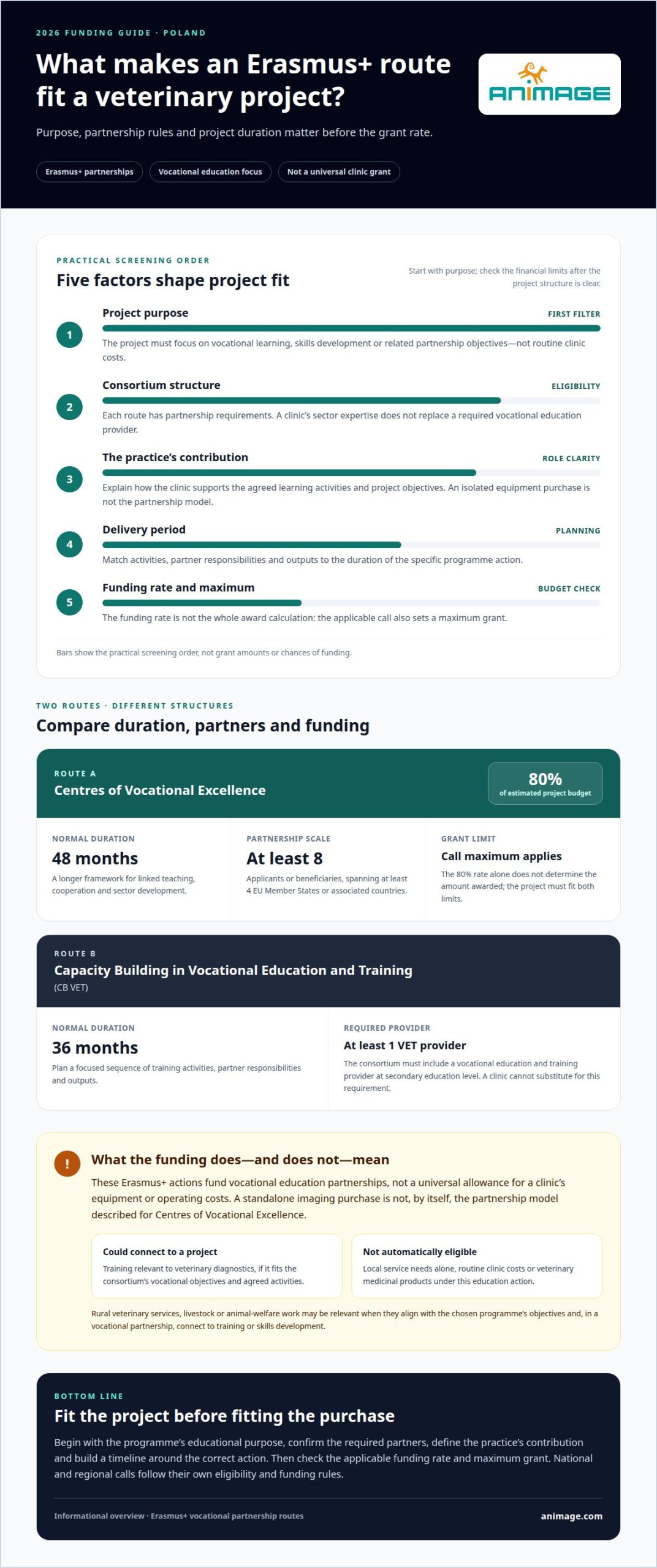
There is no single EU grant rate or maximum that applies to every veterinary practice in Poland. For Erasmus+ Centres of Vocational Excellence, the funding rate is 80% of the estimated project budget and projects should normally last 48 months, according to the European Commission. Erasmus+ CB VET projects normally last 36 months, also according to the European Commission. These are partnership programmes, not one universal allowance for a clinic’s equipment or operating costs.
It’s reasonable to focus first on the grant amount. But the call’s purpose, eligible partnership and project duration shape what a practice can realistically fund. This guide explains how the 2026 funding rules differ, what the stated rates and maximums mean, and how to assess whether a veterinary imaging investment fits the project. You’ll see where funding rules end and practical project planning begins.
Key Takeaways
- Separate funding for vocational education partnerships from grants intended for a clinic’s own investment; the programme’s purpose determines whether a project fits.
- For Centres of Vocational Excellence, the European Commission requires a partnership spanning at least 4 EU Member States or third countries associated to the Programme.
- Use the project timeline to assess whether a proposed investment can be integrated into the programme’s activities and delivery period.
- Plan around the relevant call deadline: the 2026 Centres of Vocational Excellence application deadline is 3 September at 17:00:00 Brussels time.
EU grant maximum and funding rate
For veterinary practices, the key distinction is between a project’s funding rate and its maximum grant. Under Erasmus+ Centres of Vocational Excellence, the European Commission sets the lump-sum funding rate at 80% of the estimated project budget. The applicable call also sets a maximum grant, so the rate alone does not determine the amount awarded. A project budget must fit both limits.
This programme is built around vocational education partnerships, not a general equipment allowance for an individual clinic. The European Commission requires each partnership to span at least 4 EU Member States or third countries associated to the Programme. A Polish practice would therefore need to fit into a wider cross-border project and its vocational objectives. A standalone purchase of imaging equipment is not, by itself, the partnership model described by this action.
That distinction matters when owners assess EU funding for veterinary practices 2026. An application needs a clear link between the proposed work, vocational learning and the consortium’s agreed activities. For example, stakeholders might develop training relevant to veterinary diagnostics across partner organisations. The grant framework would then cover the eligible project as a whole, rather than operate as a percentage discount on any clinic purchase.
Polish national or regional funding follows its own call rules and may target different applicants, activities or investments. The key distinction is the programme’s purpose: a Centres of Vocational Excellence application requires an international education partnership, while a national or regional call is assessed against its specific eligibility and funding conditions.
EU support may cover rural veterinary services, livestock or animal-welfare work when these align with the chosen programme’s objectives and activities. In a vocational partnership, the proposal must connect such work to training or skills development; a local service need alone does not establish eligibility. Veterinary medicinal products are a separate matter and are not automatically eligible under this education action.
Project duration
Project duration affects what a veterinary partnership can plan, implement and evaluate. The European Commission states that Erasmus+ CB VET projects normally have a duration of 36 months. Erasmus+ Centres of Vocational Excellence projects should normally last 48 months, according to the European Commission. These are different programme actions, so their timelines should not be treated as interchangeable.
A 36-month CB VET project requires a focused sequence of activities. Partners need to align the training plan, responsibilities and expected outputs with the available period. For example, a consortium involving a Polish veterinary education provider and partners in other countries could plan skills development across the project timeline. The proposal should connect each activity to the action’s objectives, rather than list disconnected tasks.
The 48-month Centres of Vocational Excellence period supports a longer partnership framework. Its members can plan linked work across teaching, cooperation and governance, then explain how these elements address sector needs. The schedule should show how the project holder will coordinate partners and implement activities over the full period. Longer duration is not a reason to expand scope without a clear purpose.
For a veterinary practice considering participation, the key question is whether its proposed contribution fits the project’s duration and educational focus. Do not assume an equipment purchase or clinical operation qualifies simply because it supports veterinary work. The application must explain how it relates to the programme action. For example, a project that includes training on diagnostic workflows needs clearly defined partner roles and an aligned delivery plan.
Keep regulatory work separate from grant timelines. EU requirements for veterinary medicinal products have their own regulations and implementation schedules; they do not replace the project period set by an Erasmus+ call. Existing procedures may inform training content, but the proposal must still address its objectives, partner roles and planned outputs. Keeping these timelines distinct helps partners create a credible schedule without confusing compliance deadlines with funded activities.
2026 EU Funding for Polish Veterinary Practices
In 2026, the relevant Erasmus+ routes are Capacity Building in Vocational Education and Training (CB VET) and Centres of Vocational Excellence. Both focus on vocational education partnerships. They are not general grants for a Polish clinic’s routine operating costs or an isolated equipment purchase. A practice’s potential role depends on how its work supports the programme’s educational objectives.
For CB VET, the consortium must include at least one vocational education and training provider at secondary education level. A veterinary practice could contribute sector expertise to a partnership’s training activities, but the provider requirement shapes the consortium. The proposal needs to define the practice’s role, the learning activities it supports and how those activities serve the project’s objectives. The clinic should not be treated as a substitute for the required education provider.
Centres of Vocational Excellence offer another partnership route. Their application is designed around cooperation in vocational skills, teaching and sector development. The European Commission requires at least 8 applicants, or beneficiaries, in a partnership. This structure may suit a veterinary organisation able to contribute to a wider skills initiative, rather than a clinic seeking funding solely for its own immediate operational needs.
To assess which route fits, start with the project’s main purpose. If the central outcome is vocational training or skills development, consider whether the practice can participate meaningfully alongside eligible education partners. If the objective is only to acquire diagnostic equipment, these Erasmus+ actions may not match that standalone need. The distinction matters for EU funding for veterinary practices 2026: a relevant clinical subject does not, on its own, make a project eligible.
A Polish practice can explore participation in either action through a project consortium, with its contribution linked to the proposed educational work. Before developing the application, identify the intended beneficiaries, training content and partner responsibilities. This keeps the proposal focused on the programme’s purpose and clarifies whether the practice will contribute clinical expertise, training capacity or another defined activity.
When are the 2026 application deadlines for relevant EU-funded programmes in Poland?
The 2026 Erasmus+ Centres of Vocational Excellence call has a defined deadline: applications must be submitted by 3 September at 17:00:00 Brussels time. The call ID is ERASMUS-EDU-2026-PEX-COVE. The deadline applies to the call, not only to Polish applicants. A Polish organisation joining a consortium must coordinate its contribution with the same submission schedule.
For a veterinary practice, the submission date is only the endpoint of a longer consortium process. Partners need time to agree on responsibilities, project activities and how the application will address vocational objectives. A clinic contributing clinical expertise should align its role with the consortium’s training plan before the proposal is assembled. Agreeing on the scope late can leave partner responsibilities and planned activities disconnected.
CB VET follows a separate call and application schedule from Centres of Vocational Excellence. Its 2026 project duration is normally 36 months, but that duration does not determine the submission deadline. Treat each Erasmus+ action as a distinct application process. Identify the exact call first, then coordinate the partner inputs and proposal preparation against that call’s published timetable.
Submission time matters. The Centres of Vocational Excellence deadline is stated in Brussels time, so Polish applicants should plan around the stated time zone rather than assume a local-time conversion. Keep the call ID with the consortium’s working documents. It helps distinguish ERASMUS-EDU-2026-PEX-COVE from other Erasmus+ actions during drafting and submission preparation.
Questions about the Centres of Vocational Excellence call need to be raised early: they must be sent at least two weeks before the submission deadline to receive a response. Early planning gives a practice and its partners time to identify unclear project roles, training activities or application requirements and incorporate responses into the proposal before submission.
Animage
Animage develops and sells FIDEX+, a multi-modality veterinary imaging platform for animal-focused clinical settings. It combines cone-beam computed tomography, digital radiography and fluoroscopy in one compact device.
If your investment plan includes diagnostic imaging, assess the equipment decision separately from the funding route. Erasmus+ partnership funding supports vocational education activities, not general equipment grants for individual clinics. FIDEX+ may suit a clinic planning to add imaging capacity, but project eligibility depends on the specific call and proposal objectives. First assess the grant framework on its own terms, then determine whether the imaging platform meets your clinical requirements.
Contact Animage to discuss FIDEX+ for your veterinary practice.
Turn your funding plan into a practical investment decision
Use your next planning step to separate two questions: what the funding programme supports, and what your clinic needs clinically. For EU funding for veterinary practices in 2026, that distinction helps prevent a proposed equipment investment from being treated as eligible simply because it serves veterinary work. Define the clinical capability you want to develop, then assess how it relates to the relevant project objectives.
When planning an imaging investment, consider which diagnostic workflows your practice needs to support and how the equipment will fit into daily operations. Animage sells FIDEX+, a veterinary imaging platform. Reviewing your imaging needs alongside the project concept can clarify the equipment decision without conflating it with grant eligibility.
Keep the funding application grounded in the programme’s purpose, and the equipment decision grounded in clinical needs. Talk with Animage about imaging for your funding plans. A clear separation makes the next decision more practical and focused.
Frequently Asked Questions
What are the funding rules?
Funding rules depend on the programme action, the applicant’s role and the project’s stated objectives. Because Erasmus+ partnership funding supports vocational education activities, a clinic’s contribution must connect to the proposal’s work plan. Separate the project budget from the practice’s wider investment plan, then assess each activity against the call’s eligibility and reporting conditions.
Where to apply?
Submit through the channel specified in the relevant programme call. For Erasmus+ actions, identify the correct call and application documents, then use its designated electronic submission route. A Polish practice joining as a partner should coordinate its information with the consortium lead, as the application describes the partnership and project as a whole, not only the clinic’s contribution.
Are there 2026 EU grants specifically for veterinary clinics or animal-health services in Poland?
The 2026 Erasmus+ actions discussed here are partnership programmes, not dedicated grants for a veterinary clinic’s standalone equipment or routine services. A practice may contribute clinical expertise to a vocational education project when that contribution supports its objectives. For example, a clinic could participate in work developing training content, provided the consortium structure and call requirements are met.
What are the eligibility requirements for Polish veterinary practices seeking EU funding?
Eligibility depends on the selected call and whether the practice applies directly or joins a consortium. For Erasmus+ vocational education actions, the proposal must meet the programme’s partner and activity requirements, and the clinic’s role should be set out in the work plan. Before the application is finalised, clarify the practice’s legal role, planned contribution and connection to training outcomes.
Which costs are eligible, such as clinic equipment, renovation, digitalisation, or energy upgrades?
Cost eligibility depends on the specific call and the project’s approved activities, not on a general list that applies to every veterinary practice. Do not assume equipment, renovation, digitalisation or energy work is eligible simply because it benefits a clinic. For an Erasmus+ education partnership, explain how each proposed cost supports the project’s vocational learning objectives and follow the call’s budget rules.
What grant amounts, funding rates, and maximum budgets are available to veterinary practices in Poland in 2026?
There is no single grant amount or rate for Polish veterinary practices across these programmes. The European Commission sets the Centres of Vocational Excellence lump-sum rate at 80% of the estimated project budget, subject to the call’s maximum grant. CB VET has a separate project ceiling. These limits apply to programme projects, not automatically to a clinic’s individual purchase budget.