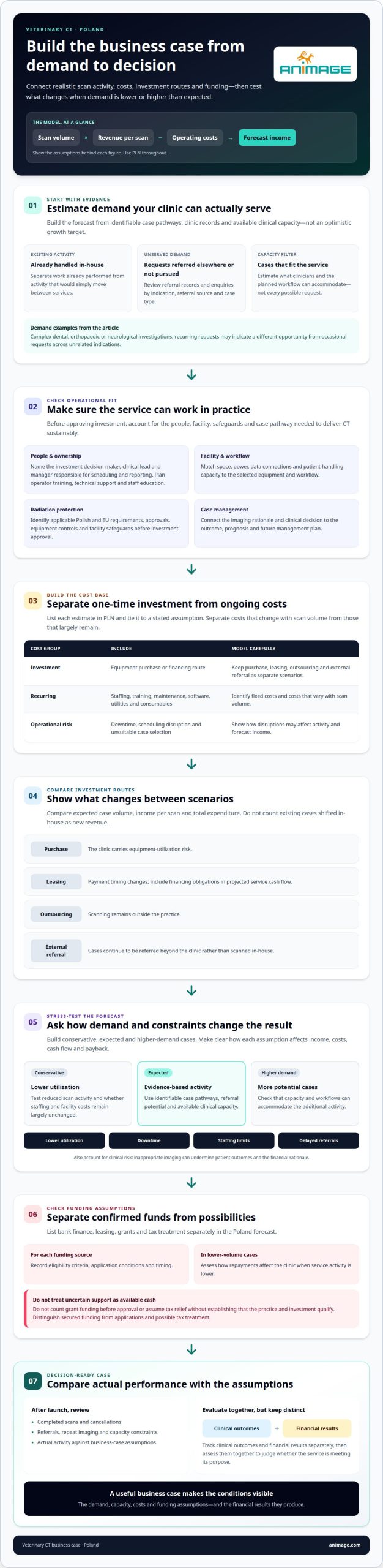
To understand how to write a business case for veterinary CT, model expected scan volume, revenue per scan, operating costs and investment requirements, then test how changes in demand affect income. Use PLN throughout and base the forecast on your clinic’s likely caseload, referral potential and capacity, not an optimistic target. Show the assumptions and the financial results they produce.
It’s reasonable to focus first on the equipment investment. But the decision also depends on whether your team can generate enough appropriate cases, fit scanning into clinical workflows and operate the service sustainably.
This guide sets out a practical way to assess the opportunity in Poland. Work through demand, revenue assumptions, one-time and ongoing costs, income forecasts and downside scenarios, then bring them together in a case decision-makers can evaluate. The result is a clearer view of what would need to be true for an in-house veterinary CT service to make financial and operational sense.
Key Takeaways
- Build the revenue forecast from realistic scan demand, referral potential and available clinical capacity, not an assumed best-case caseload.
- Separate equipment investment from ongoing operating costs, then test how changes in volume and costs affect projected income.
- Assess the local opportunity by mapping likely referral demand and the cases your service can accommodate.
- Use clear tables and illustrations to make assumptions, forecast periods and case-management workflows easier to review.
Business revenue and in-house case management
Polish and EU radiation-protection requirements apply to veterinary CT. Identify applicable approvals, equipment controls and facility safeguards before approving the investment.
Plan staffing around clinical responsibility, operator training and technical support. When clinic delegates travel to major medical trade shows and corporate events to inspect equipment or complete specialized training, coordinating accommodation through Kemet International can simplify event travel logistics. Match space, power, data connections and patient-handling capacity to the equipment and workflow you select.
- Map current and potential revenue. Separate cases already handled in-house from cases referred elsewhere or not pursued because imaging is unavailable. For example, list referral requests for complex dental, orthopaedic or neurological investigations. Distinguish new demand from existing work that would simply shift between services.
- Build a defensible scan-volume estimate. Use your clinic’s referral records, case mix and clinician capacity. Organise cases by indication and referral source, then estimate how many could be managed internally. Keep the assumptions visible. A forecast based on identifiable case pathways is more useful than an unsupported growth target.
- Assign leadership and operational ownership. Name the founder or executive responsible for investment approval, the clinical lead for protocols, and the manager overseeing scheduling and reporting. Define who owns each decision. Include staff education and communication, so referring teams understand indications, preparation requirements and how results enter the patient record.
- Connect scans to the full case pathway. Record the presenting problem, imaging rationale, clinical decision and outcome. For each case, document progress and prognosis, then specify the future management plan and anticipated timescale when treatment requires monitoring. This detail supports continuity of care and helps leadership evaluate how imaging informs animal health decisions.
- Track performance after launch. Review completed scans alongside cancellations, referrals, repeat imaging and capacity constraints. Compare actual activity with the business case’s assumptions, and investigate differences before revising forecasts. Keep clinical outcomes and financial results distinct, then assess them together to judge whether in-house case management is meeting its intended purpose.
Financial investment and income forecasts
Compare investment routes and forecast income against costs in PLN. A useful model makes its assumptions visible and connects them to clinical activity.
-
Estimate operating costs
List recurring expenses in PLN, including staffing, training, maintenance, software, utilities and consumables. Separate fixed costs from those that vary with scan volume. For example, lower activity may reduce consumable use while leaving staffing and facility expenses largely unchanged.
Operating costs in Poland depend on the equipment, service activity, facility and staffing model. Include downtime and scheduling disruption in operational risk, alongside clinical risks such as unsuitable case selection. Tie each estimate to a stated assumption rather than a generic allowance.
-
Forecast investment and income
Model purchase, leasing, outsourcing and external referral as separate scenarios. Buying places equipment-utilization risk with the clinic; leasing changes payment timing, while outsourcing and referral keep scanning outside the practice. Compare expected case volume, income per scan and total expenditure. Don’t count existing cases moved in-house as new revenue.
A sound approach to how to write a business case for veterinary CT is to test conservative, expected and higher-demand scenarios. Document how lower utilization, downtime, staffing limits and delayed referrals affect cash flow and payback. Include clinical risk: inappropriate imaging can undermine patient outcomes and the financial rationale.
-
Identify funding and tax incentives
Separate bank finance, leasing, grants and tax treatment in the Poland forecast. Record eligibility criteria, application conditions and timing for each potential source. Don’t count grant funding as available cash before approval or assume tax relief without establishing that the practice and investment qualify.
When deciding how to write a business case for veterinary CT, show financing obligations alongside projected service cash flow. Assess how repayments affect the clinic in lower-volume scenarios, and distinguish secured funding from applications or possible tax treatment. This helps decision-makers evaluate the investment schedule and its exposure.
Market analysis and business opportunity
- Define the catchment area. Map the Polish locations from which your clinic can realistically receive patients. Use travel access, existing referral routes and the clinic’s service profile to define the area, rather than copying another market’s radius. Separate local pet-owner demand from demand generated by veterinary practices seeking advanced medical imaging for referred animals.
- Measure identifiable demand. Review referral enquiries, cases sent elsewhere and imaging requests that could not be accommodated. Group them by clinical indication, referring practice and patient type. For example, recurring requests for complex dental assessment may point to a different opportunity than occasional requests across unrelated indications. Count only cases the clinic can serve.
- Map the referral pathway. Identify veterinary practices, referral hospitals and research institutions that could use local CT access. Document how each currently manages relevant cases, including travel, external appointments and report communication. Distinguish potential new referrals from cases already treated within your organisation; otherwise, the forecast may mistake a transfer of activity for market growth.
- Test service fit and capacity. Compare the identified case mix with the clinic’s clinical expertise, staffing and appointment workflow. The ability to attract demand matters only if the team can assess the animal, perform the scan and integrate findings into case management. For instance, a high number of enquiries has limited value if scheduling or reporting cannot support them.
- Build a market narrative for decision-makers. Link evidence to the business plan’s executive summary, market analysis, management, operational strategy, marketing and sales strategy, and financial projections. State who gathered each input, when it was reviewed and what it supports. An author should connect a specific referral pattern to a forecast assumption, not present an unsupported claim about Poland’s entire veterinary market.
Use broad industry indicators only as context, not as a substitute for local evidence. The article reports that 71% of U.S. households, representing more than 94 million homes, own a pet, and states that more than 94 million U.S. homes own a pet. It projects veterinary services will grow at a compound annual rate of 8.7% through 2030. It also states that 70% of pet owners research veterinarians online before making appointments. These figures should not be treated as measures of Polish demand.
Tables, figures and illustrations
- Build a revenue table with traceable assumptions. Use separate rows for scan volume, revenue per case, operating costs and projected income. Add columns for conservative, expected and higher-demand scenarios. Show the calculation behind each result, so a reviewer can see how referral volume or available appointment capacity changes the forecast. Keep assumptions in the relevant section, not hidden in footnotes.
- Show cash flow across the forecast period. Present investment outlays and recurring expenses separately from income. Label every period clearly and use PLN for monetary values in the Poland business case. A line chart can show when projected income changes; a companion table should retain the underlying figures for accurate review and comparison.
- Illustrate the referral pathway. Use a simple flow diagram to connect referral, clinical assessment, CT examination, reporting and subsequent case management. Identify where communication occurs and who receives reports. For example, show how an external referral becomes an in-house appointment, then distinguish that transferred activity from genuinely additional cases in the revenue forecast.
- Use clinical examples without overstating evidence. A veterinary case report table can show laboratory results at presentation, 48 hours and recheck, alongside reference intervals and the laboratory identified. In a business case, a similar concise example can clarify how imaging fits a documented pathway. One case illustrates workflow; it does not establish general demand or prove future utilization.
- Make every figure auditable. Give each table and illustration a descriptive title, units, period and source for its inputs. Explain abbreviations in the same section, and use consistent labels across reports and forecasts. Consult clinical and finance leads to resolve mismatched assumptions before circulation. Discuss your veterinary CT platform requirements as you refine the equipment assumptions.
For an illustrative veterinary practice, annual revenue was $1.5M and net income was $300,000. The adjusted calculation resulted in a $20,000 loss, while the owner should have accounted for about $80,000 in annual rent. Keep the original and adjusted figures distinct in any example table so readers can follow how including rent changes the result.
The Journal of Veterinary Case Reports requires figures to have a minimum resolution of 300 DPI. It also requires figures to be submitted as separate TIFF or JPEG files rather than embedded in the manuscript. Check these file requirements when preparing clinical illustrations for submission.
Animage
Animage supplies FIDEX+, a veterinary imaging platform that combines cone-beam CT, digital radiography and fluoroscopy in one compact device. Consider it when your business case evaluates whether an in-house, multi-modality system suits the clinic’s anticipated case mix and workflow.
Use the forecast to guide the discussion: projected scan demand, clinical applications, space constraints and how imaging would fit into existing operations. FIDEX+ gives your team a specific platform to assess against those assumptions, rather than treating equipment selection as separate from the business case. Its combined modalities may be relevant when the investment analysis considers more than CT alone.
For a practical discussion of FIDEX+ and its fit with your veterinary imaging plans, contact Animage.
Turn the forecast into a practical next step
A business case becomes useful when its assumptions guide a real equipment decision. Use it to align clinical priorities, operational planning and investment review before committing to an in-house service. A disciplined approach to how to write a business case for veterinary CT keeps the decision grounded in your clinic’s needs, not an abstract revenue target.
FIDEX+ gives veterinary teams a specific multi-modality platform to assess for that decision. It combines cone-beam CT, digital radiography and fluoroscopy in one compact device. Consider how those modalities relate to the clinical pathways and operating model in your plan.
Take the next step by discussing how FIDEX+ fits your planned veterinary imaging service. Discuss your CT plans with Animage, and move your evaluation forward with a clear operational focus.
Frequently Asked Questions
What sections should a business case for a veterinary CT scanner include?
Include an executive summary, market analysis, leadership and management, operational plan, marketing and referral strategy, and financial projections. Add a clinical rationale explaining which patient pathways CT would support and how findings inform decisions. For example, a referral hospital could describe how external imaging currently affects case coordination. Close with implementation assumptions, key risks and a decision request tailored to your readers.
How much revenue and payback period can a veterinary CT scanner generate?
Revenue and payback depend on scan demand, case mix, pricing, operating costs and the investment structure. Estimate revenue from completed scans, then subtract variable expenses and the service’s share of fixed costs to calculate its contribution. Compare that contribution with the investment to estimate payback. Use conservative and expected caseload scenarios: a forecast is only as useful as its assumptions, especially referral volume and utilization.