The purchase price is only one part of financing a veterinary CT scanner. In Poland, assess the equipment configuration and associated costs against your practice’s cash flow and expected imaging workload. The financing structure matters too: some arrangements may include software or installation, while others cover hardware only.
A large upfront investment can put pressure on working capital, especially before referral volume and scan revenue build. That makes the monthly commitment, included costs and expected time to steady utilisation as important as the scanner itself.
This guide explains what shapes the total investment, how equipment loans and leases differ, and how to compare repayments with a gradual revenue ramp-up. It also considers when combining CT with other imaging modalities may make operational and financial sense. Use it to compare financing options against your clinic’s actual needs, rather than relying on a one-size-fits-all calculation.
Key Takeaways
- Compare financing structures by what they include, not only by the monthly payment; software, installation and service can change the total commitment.
- Model repayment against a gradual increase in scan volume, while accounting for staffing, operating costs and the time needed to build referrals.
- Assess whether combining imaging equipment in a larger financing arrangement fits your practice’s plans and cash-flow needs.
- Explore how FIDEX+ integrates veterinary CT, digital radiography and fluoroscopy in one compact system when considering a multi-modality imaging setup.
Can financing terms accommodate the revenue ramp-up period after a major equipment installation?
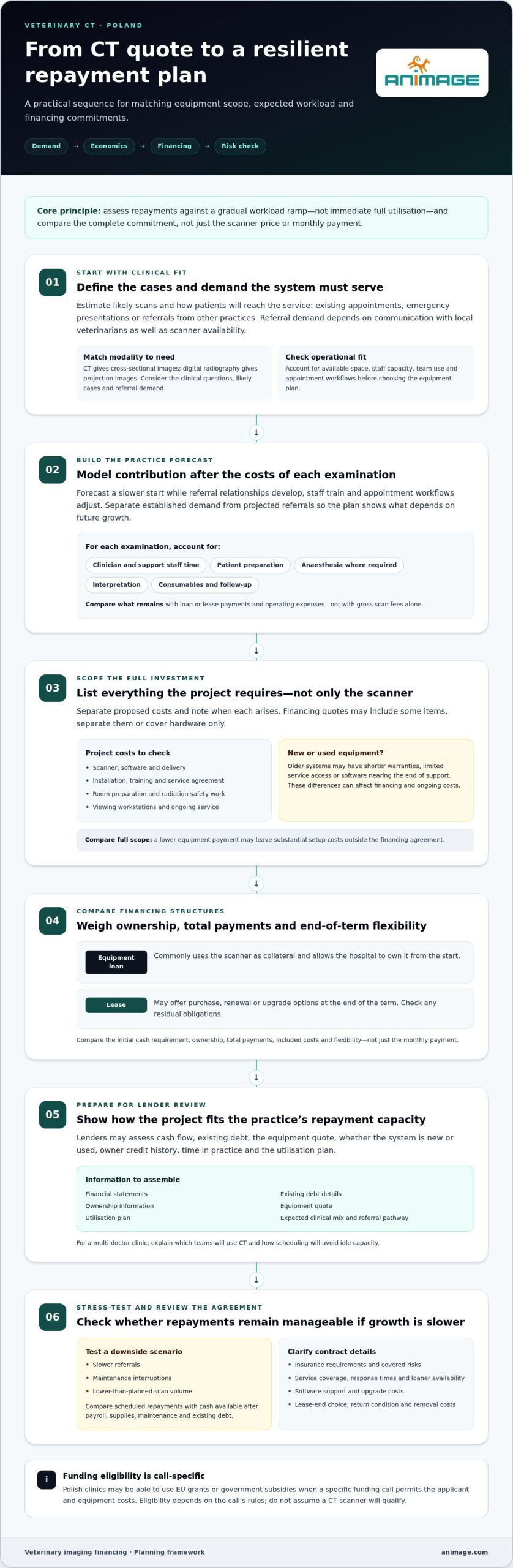
They can, provided repayments are assessed against the clinic’s expected workload rather than immediate full utilisation. Model a slower start: referral relationships take time to develop, staff need training, and appointment workflows may need adjustment. Compare projected monthly payments with cash available after payroll, supplies, maintenance and existing debt. Repayments that strain working capital before imaging volume grows can undermine the investment.
Bundling can simplify the investment. A financing package may combine the scanner with software, installation, training and a service agreement in one monthly payment. Other quotes may separate these costs or finance hardware only. Compare the full scope, including delivery, room preparation, radiation safety work, viewing workstations and ongoing service. A lower equipment payment may leave substantial setup costs outside the agreement.
Choose imaging capabilities to match diagnostic demand. CT provides cross-sectional images; digital radiography produces projection images, while ultrasound uses sound waves. MRI may suit different clinical questions and workflows. Match the equipment to likely cases, referral demand, available space and staff capacity. New and refurbished or used systems can also have different financing implications: older equipment may come with shorter warranties, limited service access or software nearing the end of support.
Polish clinics may be able to use EU grants or government subsidies when a specific funding call permits the applicant and equipment costs. Eligibility depends on the call’s rules, so do not assume a CT scanner will qualify.
Lenders assess cash flow, existing debt, the equipment quote and whether the system is new or used. Prepare financial statements, debt details, ownership information, the quote and a utilisation plan. Credit history and time in practice may also affect the review.
Review the agreement’s insurance requirements, covered risks and terms for any claim payment. Check service coverage, response times, loaner availability, software support and upgrade costs. At lease end, the contract may require purchase, renewal, upgrade or return. Before signing, clarify the return condition, removal costs and any outstanding obligations.
Veterinary CT financing and practice economics
A CT scanner changes a hospital’s cost base before it changes revenue. Assess it as a diagnostic capability with recurring financing payments, operating costs and staff time. Start with the cases you expect to scan, then estimate how they will reach the service: through existing appointments, emergency presentations or referrals from other practices. Each channel affects utilisation differently. A referral service, for example, depends on communication with local veterinarians as well as scanner availability.
Build a practice-level forecast around contribution, not gross scan fees. For each examination, account for clinician and support staff time, patient preparation, anaesthesia where required, interpretation, consumables and follow-up. Compare the remaining contribution with loan or lease payments and the system’s operating expenses. Separate established demand from projected referrals to show whether repayments depend on current activity or future growth.
Financing can preserve working capital for payroll, supplies and other growth priorities, rather than tying available funds into an outright purchase. An equipment loan commonly uses the scanner as collateral and allows the hospital to own it from the start. A lease may offer purchase, renewal or upgrade options at the end of its term. Compare ownership, total payments, residual obligations and flexibility, not just the initial cash requirement.
Underwriting links the financing structure to the practice’s economics. Lenders may consider cash flow, existing debt, the equipment quote, whether the system is new or used, owner credit history, time in practice and the utilisation plan. Your forecast should explain the intended clinical mix and referral pathway. In a multi-doctor clinic, identify which teams will use CT and how scheduling will avoid idle capacity.
Finally, test a downside scenario: slower referrals, maintenance interruptions or lower-than-planned scan volume. A sound decision keeps scheduled repayments manageable without assuming immediate full utilisation. Compare that scenario with the clinic’s available working capital before choosing a term or ownership structure.
Bundling imaging into a larger loan
A CT scanner can be one part of a broader hospital or clinic investment. An expanding referral practice, for example, may plan imaging equipment alongside diagnostic software, viewing workstations and other clinical upgrades. A larger loan may bring eligible project costs into one financing structure, but the lender will still assess the full project, its cash flow and the practice’s repayment capacity.
Separate proposed costs before comparing financing structures. List the scanner, software, delivery, installation, room work, training and service arrangements. Some financing quotes may include installation and software; others may finance hardware only. This affects the amount the practice must fund separately. A clear project schedule also shows when each cost arises, rather than treating every expense as part of the scanner price.
Bundling makes sense only when each component meets a defined clinical need. Map expected patient cases to imaging capabilities: CT provides cross-sectional images, while digital radiography produces projection images. If a project includes multiple modalities, consider how staff, referrals and appointment workflows will use them together. A larger package should reflect a coherent diagnostic plan, not simply a longer equipment list.
Loan structure matters. A conventional loan may finance imaging equipment as part of a hospital expansion or acquisition project, subject to lender review. Compare one combined facility with separate equipment financing by examining repayment timing, collateral, ownership and any conditions on project spending. A single payment can simplify cash-flow planning, but may also tie the equipment to a wider borrowing commitment.
Use a scenario to test the fit. If a clinic plans a CT suite and additional diagnostic capacity, forecast the combined operating costs and likely referral activity, then compare them with scheduled repayments. Include installation delays and a gradual utilisation ramp-up. Keep the project’s clinical purpose visible in the forecast. A considered multi-modality imaging configuration can help frame which capabilities belong together before financing terms are assessed.
Veterinary CT scanner financing
Financing a veterinary CT scanner in Poland starts with matching the system to the examinations your practice intends to perform. Computed tomography creates cross-sectional images that can help assess an animal’s bones, soft tissues and complex anatomical structures. Cone-beam CT and conventional multidetector CT serve different clinical workflows. The right purchase depends on case mix, patient size, referral demand and the scans your team expects to interpret.
Polish lenders set down payments, interest rates and repayment periods based on the clinic’s financial profile, the equipment quote and the financing structure. Cash flow, existing liabilities, credit history, equipment age and projected utilisation can all influence the offer. Compare total repayment and any end-of-term obligations, not only the initial contribution or monthly instalment.
Loans and leases lead to different ownership outcomes. An equipment loan commonly uses the scanner as collateral and gives the hospital ownership from the start. A lease may include an end-of-term purchase, renewal or upgrade option. For a used system, lenders may also require an inspection or appraisal. With either structure, align the repayment period with the scanner’s expected useful life.
Build the financing request around the full installation scope. Include the system, imaging software, delivery, installation, workstations and staff training where applicable. Room modifications, radiation protection and electrical work can affect the project budget. Lenders may finance some of these costs, while others restrict funding to hardware. List each cost separately to identify what the proposed facility covers.
Before signing, test repayments against a gradual increase in CT cases. Include interpretation, staffing, maintenance and downtime in your forecast. Review insurance conditions, service coverage, software support and upgrade costs. A lower instalment can still be a poor fit if the term extends beyond the equipment’s useful life or limits future replacement choices.
For clinics assessing system configuration alongside financing, explore veterinary CT system options.
Animage: FIDEX+
Animage’s FIDEX+ combines veterinary cone-beam computed tomography, digital radiography and fluoroscopy in one compact imaging platform. For a clinic comparing a standalone CT purchase with broader diagnostic capability, this multi-modality system is an option to assess against projected case mix, available space and financing structure.
Consider how the modalities fit daily workflows. CT provides cross-sectional images, while digital radiography and fluoroscopy support different imaging tasks. Combining them in one device may suit practices planning to develop several imaging capabilities within a single equipment footprint. The decision still depends on your clinic’s clinical requirements and financial model.
Include FIDEX+ in your veterinary imaging equipment assessment. Contact Animage to discuss the system or visit animage.com.
Make the Next Decision on Clinical Fit
Start by defining what the imaging system needs to do in your practice, then assess how that choice fits your investment plan. Financing a veterinary CT scanner should support a clinical direction your team can sustain, not simply add equipment to the balance sheet. Consider whether a broader imaging workflow would serve your patients and referral relationships better than a single-modality purchase.
Animage offers FIDEX+, a veterinary imaging platform that integrates cone-beam CT, digital radiography and fluoroscopy. For practices evaluating multi-modality imaging, it is a specific system to consider alongside clinical priorities and financing assumptions. Base the decision on fit: the cases you expect to handle, the workflows your team can support and the capabilities you intend to develop.
Contact Animage to discuss FIDEX+ and your imaging plans. A clear clinical brief is a practical starting point for the next conversation, and for a more deliberate investment decision.
Frequently Asked Questions
How Much Does a Veterinary CT Scanner Cost in Poland?
For a Polish clinic, the investment depends on the CT configuration, whether the system is new or refurbished, and the scope of the purchase. Software, workstations, delivery, installation and service arrangements also affect the total. The price depends on the specific project and is provided after a quote request. Itemised quotes help distinguish equipment costs from installation and ongoing operating expenses.
How many CT scans does a veterinary clinic need to perform to justify the investment?
There is no universal scan threshold. Calculate it by dividing annual fixed costs by the contribution from each examination after variable costs. Include interpretation, staff time, consumables and patient preparation in the per-scan calculation. Then compare the result with current demand and plausible referral growth. This shows the workload needed to cover costs without assuming the scanner reaches full utilisation immediately.
What Additional Costs Should Veterinary Practices Consider?
Separate setup costs from recurring costs before assessing affordability. Beyond the scanner, account for room readiness, electrical work, radiation protection, software, workstations and staff training. Ongoing budgets may include interpretation, maintenance, software support, consumables and insurance. For example, a system that requires workflow changes may also need staff time for scheduling and patient preparation, even if those hours do not appear on the equipment invoice.
What financing options are available for veterinary CT scanners in Poland, including leasing and loans?
Polish practices can compare equipment loans, leasing and financing as part of a wider hospital expansion or acquisition project. A loan commonly supports ownership from the start, while a lease may include end-of-term purchase, renewal or upgrade options. EU grants or public subsidies may apply when a specific funding call allows the clinic and equipment costs. Treat grant funding as conditional, not as assumed project capital.
How do leasing, bank loans, rental, and pay-per-scan arrangements compare for veterinary CT scanners?
A bank equipment loan can provide ownership from purchase, with the financed system commonly serving as collateral. Leasing separates use from immediate ownership and may define purchase or renewal options at term end. Rental avoids a purchase commitment but is governed by the rental contract; pay-per-scan links charges to usage where those terms are offered. Compare the total commitment, service responsibilities, usage limits and exit conditions.