Equipment alone doesn’t make in-house imaging financially sound. A business plan for in-house veterinary imaging should connect local demand and competing corporate-owned practices with equipment and facility costs in złoty, staffing, pricing, and financial projections. The key decision is whether expected imaging activity can support the investment and ongoing costs.
Look beyond the purchase price. Include expected case volume, average transaction value, operating costs, and a break-even forecast, then compare your clinic’s imaging offer with access and services at nearby practices. Focus the comparison on local demand and service fit, rather than assumptions about competitors.
This article sets out how to build the plan: define the business case, map equipment and space requirements, forecast income and costs, and test break-even assumptions against local competition. The result should be a practical decision model for a Polish veterinary clinic, not a generic startup template.
Key Takeaways
- Build the imaging plan around local demand, referral potential, and the services competing practices already provide.
- Separate equipment, space, staffing, and operating expenses so the full investment is visible in your Polish złoty budget.
- Forecast case volume, average transaction value, and ongoing costs to see what drives break-even.
- Use the plan to compare in-house imaging with referral options and decide how it fits your clinic’s wider service model.
What should a veterinary clinic business plan include?
Build the plan around your clinic’s format, target cases, and diagnostic role. For a business plan for in-house veterinary imaging, distinguish routine outpatient work from inpatient and referral demand.
-
Set the Service Mix and Revenue Streams
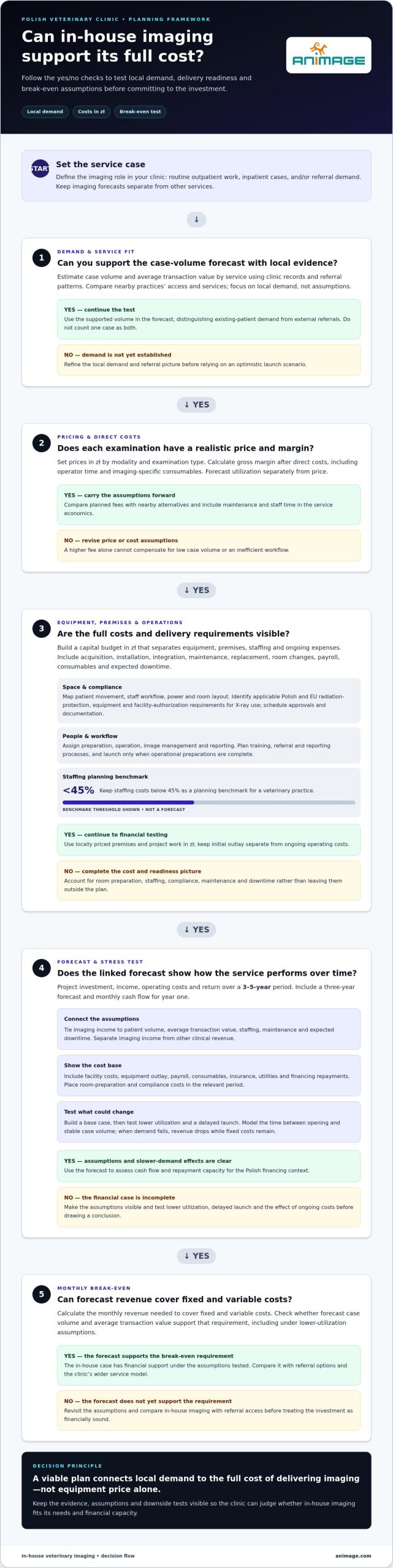
Define which veterinary services the practice will provide and which cases imaging should support. Forecast outpatient consultations, inpatient care, surgery, laboratory diagnostics, and imaging separately. Estimate the expected case volume and average transaction value for each service using clinic records and referral patterns.
Compare a general practice format with an imaging-focused special interest model. A membership plan may support recurring preventive-care revenue, but it should not replace case-based imaging forecasts. Check how imaging fits into the clinical workflow, who will interpret studies, and whether demand is expected from existing patients or external referrals. Avoid counting one case as both a referral and an internal visit.
-
Estimate Imaging Prices and Profit Margins
Set separate prices in zł for each modality and examination type. There is no single useful price for every clinic in Poland: fees should reflect the modality, staff time, consumables, maintenance, and local demand. Compare planned fees with nearby alternatives and the value of keeping the diagnostic pathway within your practice.
Calculate the gross margin for each service by subtracting direct costs from revenue, then dividing the result by revenue. Include operator time and imaging-specific consumables rather than treating equipment use as cost-free. Forecast utilization separately from price. A high fee cannot make up for low case volume or an inefficient workflow.
-
Plan Imaging Service Implementation
Plan implementation in sequence: define clinical use, assess room and workflow needs, compare equipment configurations, and include purchase and operating costs. Before purchase, identify the applicable Polish licensing and facility requirements for the selected modality, then build them into the project schedule.
Next, assign staff responsibilities, prepare referral and reporting workflows, and set a launch date only when training and operational preparations are complete. Explain the service clearly to existing clients and referring practices. After launch, track inquiries, completed examinations, and referral sources. This ties promotion to measurable demand, not impressions alone.
Veterinary imaging and other equipment costs
Build a capital budget in zł that separates equipment, premises, staffing, and ongoing costs. Test every assumption against expected use, not an optimistic launch scenario.
- List the full equipment package for each planned modality, including acquisition, installation, and integration with clinical workflows. Add related diagnostic equipment, such as dental or laboratory equipment, only if it supports the clinic’s service mix. Forecast maintenance and replacement costs separately from the purchase budget. Investors need to see both the initial outlay and the ongoing cost of keeping equipment operational.
- Map the clinic space before comparing equipment configurations. Account for access, patient movement, staff workflow, and any room changes required by the selected system. In Poland, include a compliance workstream to identify applicable Polish and EU radiation-protection, equipment, and facility-authorization requirements for X-ray use. Schedule the relevant approvals and documentation as part of the project, rather than leaving them until after purchase.
- Forecast clinical staffing and delivery costs for each examination type. Include the time needed to prepare patients, operate equipment, manage images, and complete reporting. Model utilization conservatively: if demand falls below forecast, revenue drops while fixed costs remain. Also assess downtime, maintenance delays, and the effect of unavailable imaging on referrals and existing clients. A strong plan explains how the clinic will manage these operational risks.
- Separate premises and build-out costs from medical equipment. Estimate required changes from the actual floor plan, including power, room layout, storage, and patient flow. Avoid importing another country’s startup budgets as Polish estimates. Instead, price local premises and project work in zł, then model how lease or renovation costs affect cash flow. Keep staffing assumptions visible too: a veterinary practice should keep staffing costs below 45% as a planning benchmark.
Financial forecasting and break-even planning
Build linked forecasts for the imaging service and the wider practice. Use zł throughout, and make assumptions clear to lenders and owners.
-
Prepare Financial Projections
Project investment, income, operating costs, and return over a 3-5-year period. Include a three-year forecast and monthly cash flow for year one. Separate imaging income from other clinical revenue, and tie each projection to patient volume, average transaction value, staffing, maintenance, and expected downtime.
Include facility costs, equipment outlay, payroll, consumables, insurance, utilities, and financing repayments. Model the time between opening and reaching stable case volume. Build a base case, then test lower utilization and a delayed launch. Assign compliance and room-preparation costs to the relevant period rather than hiding them in general overhead.
For financing preparation in Poland, organize the investment schedule, cash-flow forecast, and assumptions behind projected income. SBA loan materials relate to a U.S. financing framework, so do not present them as a Polish funding route. Give Polish lenders a clear explanation of repayment capacity and the impact of slower demand.
-
Analyze Break-Even
Calculate the monthly revenue needed to cover fixed and variable costs. Divide monthly fixed costs by the contribution per examination, meaning the fee minus direct costs. This gives the case volume needed to reach operating break-even. Compare that volume with appointment capacity, staffing availability, and the referral pipeline.
Run separate scenarios for lower utilization, maintenance downtime, and slower client acquisition. Include how competitors’ services could affect referrals and patient retention. If the required case volume exceeds realistic capacity, revise the service scope, staffing plan, or launch schedule before committing capital. Each month, compare actual cases, income, and expenses with the forecast.
Business plan purpose and structure
Use the plan to decide whether imaging is a viable opportunity for your veterinary practice. A clear structure also aligns ownership, staffing, launch priorities, and financial assumptions.
- Define the decision the plan must support. State whether imaging will serve existing patients, attract referrals, or establish a focused service for a particular animal population. Describe the clinic’s format and how imaging supports its broader veterinary services. This keeps the plan tied to a practical ownership decision, rather than making equipment purchase the objective.
- Describe the local market and competing practices. Map nearby independent clinics and corporate-owned veterinary practices by their services, referral roles, and the cases your clinic could serve. Distinguish unmet demand from demand already served by competitors. Use this comparison to explain the opportunity and identify the client groups the planned service will reach.
- Connect the service model to daily operations. Document who will manage appointments, prepare each patient, operate the equipment, and coordinate image interpretation. Show how imaging fits existing clinical workflows and where staffing or room changes are needed. A practical launch plan assigns responsibility for each task instead of assuming the current team can absorb the extra work.
- Organize the financial case into investment, operating costs, income assumptions, and cash flow. Keep equipment and facility costs distinct from ongoing staffing and maintenance. Link projected revenue to expected case sources and service capacity. Use a 3-5-year planning horizon, then test whether slower uptake changes the ownership decision or launch sequence.
- Turn the analysis into decisions and review dates. Summarize the selected format, main risks, launch milestones, and conditions for expanding or revising the service. Set concrete actions for the next 90 days, then update the plan annually. Reassess the practice’s mission and direction about every three years as local competition and client needs evolve. To explore system fit, review imaging platform options against your planned workflow.
Animage: FIDEX+
FIDEX+ is Animage’s multi-modality veterinary imaging platform, integrating cone-beam computed tomography (CT), digital radiography, and fluoroscopy in one compact device designed for animals. For a clinic assessing in-house imaging, consider this configuration alongside the planned service mix, available space, expected case flow, and financial forecast. It brings three imaging modalities into a single system, rather than requiring plans for separate devices. Include its intended clinical use and workflow requirements in your equipment assessment. The right fit depends on how the platform aligns with your clinic’s diagnostic needs and operating model. Contact Animage to discuss FIDEX+ for your veterinary practice.
Move from forecast to a defined next step
Use your business plan for in-house veterinary imaging as a decision tool, not a document that ends when equipment is selected. Set clear internal milestones for workflow readiness, staff responsibilities, and reviewing actual demand after launch. This gives ownership a practical basis for adjusting the service as the clinic learns from real cases.
Before committing, compare the planned workflow with the imaging platform’s configuration and role in your practice. Animage offers FIDEX+ to clinics assessing an integrated veterinary imaging option. The next step is a focused discussion about how the platform relates to your intended service model, space, and financial assumptions.
Discuss your imaging plans with Animage. A well-defined next step keeps the decision grounded in your clinic’s operational needs and gives your team a clear path forward.
Frequently Asked Questions
Does the plan address competing with corporate-owned practices?
Yes. Compare the services, referral pathways, and patient access offered by corporate-owned practices with your clinic’s proposed role. For example, your clinic might differentiate itself through closer coordination between imaging and follow-up appointments, or by accepting suitable referrals from other practices. Consider how corporate competitors could respond, but base your forecast on identifiable case sources and your own capacity, not assumptions about their strategy.
What should a business plan for in-house veterinary imaging in Poland include?
Include the service model, local demand, equipment and premises requirements, staffing, operating expenses, revenue assumptions, and financing outlook. For a Polish practice, record costs in zł and separate one-time investment from recurring expenses. Add a workflow map showing how a patient moves from referral or consultation through imaging, interpretation, and follow-up. Assign responsibility for each implementation task and define what evidence will trigger expansion or a change in scope.
What are the purchase and installation costs for veterinary X-ray, ultrasound, CT, and MRI equipment in Poland?
Costs depend on the modality, equipment configuration, installation requirements, room preparation, and integration with existing systems. Compare options using a like-for-like schedule in zł, including delivery, setup, training, maintenance, and any required facility work. For example, ultrasound and MRI have different operational and space implications, so the purchase figure alone cannot show their full financial impact. Avoid applying a foreign clinic’s budget directly to a Polish project.
What staffing, training, and operating costs are required for an in-house veterinary imaging department?
Plan for the people and time needed to prepare patients, operate equipment, manage images, coordinate interpretation, and communicate findings. Costs depend on the clinic’s examination mix and whether existing staff can cover these tasks without disrupting other appointments. Include training time, payroll, maintenance, consumables, software, and cover during staff absences. A role-by-role schedule can reveal hidden workloads that a general staffing budget would miss.
What space, construction, shielding, and safety requirements apply to veterinary imaging rooms in Poland?
Plan room requirements around the selected modality, equipment layout, animal handling, staff movement, and the facility’s existing design. For X-ray use, assess shielding, controlled access, operating procedures, and applicable Polish authorization requirements before finalizing the room plan. The work required depends on the installation and equipment. Keep design and compliance decisions separate from ordinary clinic renovation assumptions.
How does in-house veterinary imaging compare financially with referrals to external diagnostic imaging providers?
Compare the total cost and contribution of each pathway, not just the referral fee or equipment purchase. Referrals avoid direct equipment ownership costs, while in-house imaging adds staffing, maintenance, and facility expenses but may keep more of the diagnostic workflow within the practice. Model case volume, referral retention, interpretation arrangements, and downtime. The better option depends on whether expected use supports the additional operating commitments.