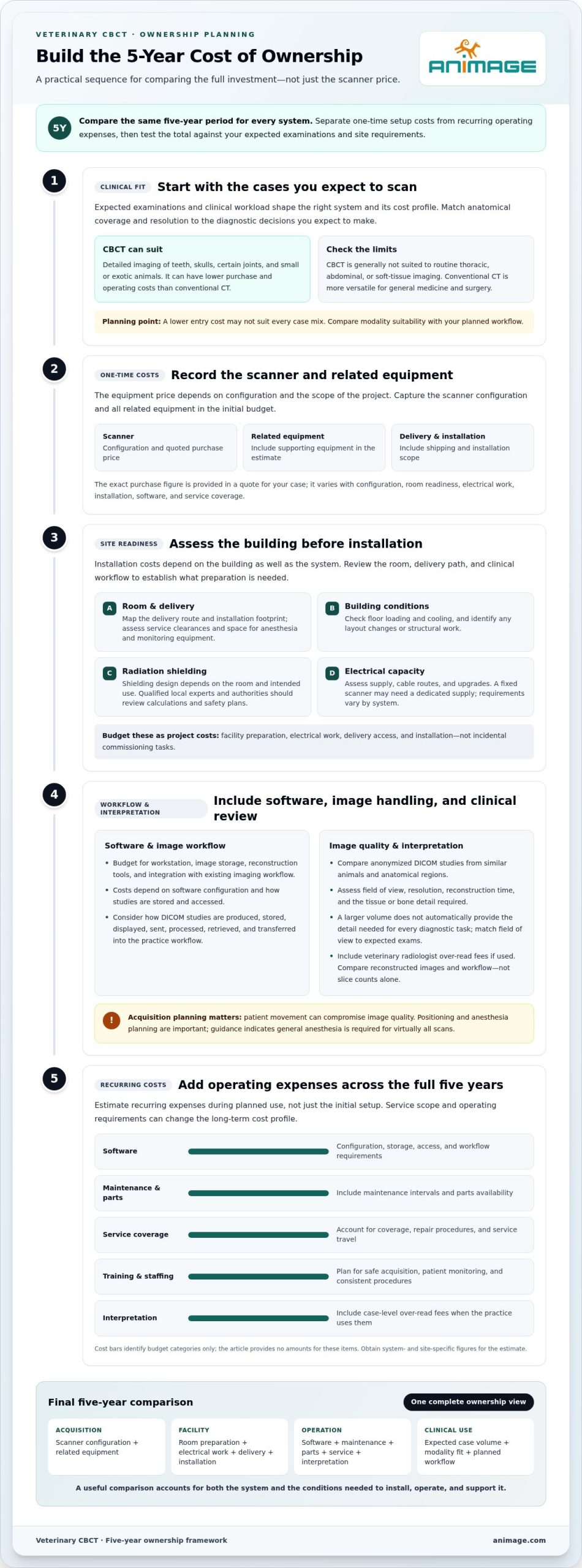
The scanner’s purchase price is only one part of a five-year budget. The total cost of ownership for veterinary CBCT also depends on installation, facility preparation, software, maintenance, and service. For a Polish practice, compare the full cost of owning and operating a system over five years, not just the equipment price.
This distinction matters: a system that fits the clinical workload and existing space has a different cost profile from one that requires substantial facility work or ongoing service. Start with the examinations you expect to perform, then account for the equipment and operating requirements behind them.
This article explains the factors that shape scanner costs, installation and software expenses, and five-year ownership budgets. It also considers how a multi-modality platform can support a clinic’s imaging needs, helping you assess the investment in practical terms.
Key Takeaways
- Include facility readiness, electrical work, delivery access and installation in the budget, not just the scanner itself.
- Assess software and image interpretation around the studies your practice performs and how images move through the clinical workflow.
- Build a five-year estimate that accounts for maintenance, parts, service travel, training and related equipment alongside the initial purchase.
- Plan staffing and training around safe image acquisition, patient monitoring and consistent operating procedures.
Installation and facility preparation costs
Installation costs depend on the building as well as the CT system. A room that accommodates the scanner, delivery route, and clinical workflow may need less preparation than one requiring structural changes. Before planning installation, assess floor loading, cooling, service clearances, and space for anesthesia and monitoring equipment. These details determine whether equipment can be delivered, positioned, and operated effectively.
Room construction can involve layout changes and radiation shielding. Lead-lined drywall is one possible shielding material, but the design depends on the room and its intended use. Qualified local experts and authorities should review shielding calculations and radiation-safety plans, because requirements vary by location. The International Atomic Energy Agency provides guidance on veterinary facility design and protecting workers and the public.
Electrical work is another facility cost driver. A fixed scanner may need a dedicated supply, while a cone-beam system may have different technical requirements. Existing building capacity, cable routes, and required upgrades determine the work involved. Include electrical assessment and installation in the project budget rather than treating them as incidental commissioning tasks.
The purchase is only the starting point for operating costs. Software, maintenance, parts, service travel, and training can all affect the ownership budget. Extended service coverage adds recurring costs, depending on covered components, maintenance intervals, and repair procedures. For refurbished equipment, parts availability and ongoing service support also affect the practical cost of operation.
The purchase price depends on system configuration, room readiness, electrical work, installation scope, software, and service coverage. The exact figure is provided in a quote for your case.
- Map the delivery route and installation footprint.
- Assess shielding, floor loading, cooling, and electrical capacity.
- Include software, maintenance, parts, and service coverage in the operating budget.
Software, image reconstruction, and interpretation
Software affects how a veterinary CBCT study moves from acquisition to clinical review. Budget for the workstation, image storage, reconstruction tools, and integration with the clinic’s existing imaging workflow—where platforms from radiology management providers like SMAART Medical Systems, Inc. illustrate how clinics structure PACS and archiving costs. Costs depend on the software configuration and how the practice stores and accesses studies. Include these technical and recurring requirements in the ownership estimate, not just the scanner’s initial setup.
CBCT uses a cone-shaped X-ray beam and an area detector to create three-dimensional reconstructions. These images support assessment and treatment planning, but their diagnostic value depends on the anatomy, image quality, and clinical question. DICOM is the standard for producing, storing, displaying, sending, processing, and retrieving medical imaging information. Before acquisition, consider how the system handles DICOM studies and transfers them into the practice’s workflow—an area where technical partners like Sydeso often help businesses build and manage tailored software solutions to connect internal systems.
Compare image quality using anonymized DICOM studies from similar animals and anatomical regions. Assess the field of view alongside resolution, reconstruction time, and the level of tissue or bone detail required. A larger volume may capture more anatomy, but it does not automatically provide the detail needed for every diagnostic task. Match the field of view to expected examinations, such as dental, skull, or joint imaging.
Interpretation also affects operating costs. If the practice uses veterinary radiologist over-reads, include those fees in its case-level calculations. Patient movement can compromise image quality, so positioning and anesthesia planning matter. Veterinary CBCT guidance indicates general anesthesia is required for virtually all scans. When evaluating software, compare reconstructed images and workflow performance, not just displayed slice counts. A higher reconstructed slice count does not necessarily mean the scanner acquired the same number of independent slices. These distinctions help clinics assess diagnostic utility and operating requirements before selecting a system.
Five-year total cost of ownership
A five-year estimate of the total cost of ownership for veterinary CBCT includes more than scanner acquisition. It combines installation and facility work with operating expenses across the equipment’s planned use. This allows a practice to compare systems consistently, rather than treating the purchase price as the full investment. Build the estimate around expected examinations and the site’s technical requirements.
Clinical fit shapes costs over time. Cone-beam CT can have lower purchase and operating costs than conventional CT, and it suits detailed imaging of teeth, skulls, certain joints, and small or exotic animals. Conventional CT is more versatile for general medicine and surgery. CBCT is generally not suited to routine thoracic, abdominal, or soft-tissue imaging. A lower entry cost may not suit every case mix, so match anatomical coverage and resolution to the diagnostic decisions you expect to make.
For a useful five-year comparison, separate one-time expenses from recurring costs. Include shipping, installation, facility work, related equipment, and training in the initial budget. Then account for software, maintenance, parts, service travel, and interpretation during operation. Service requirements affect long-term costs, particularly for refurbished scanners, where parts availability and ongoing support matter.
- Acquisition: record the scanner configuration and related equipment.
- Facility: include room preparation, electrical work, delivery, and installation.
- Operation: estimate software, maintenance, parts, service travel, and interpretation.
- Clinical use: compare expected case volume and modality suitability with the planned workflow.
Compare the same five-year cost categories for each system. Include warranty scope, X-ray tube and detector coverage, maintenance intervals, remote diagnostics, spare-parts access, response time, and major-repair procedures. These terms affect downtime and future expenses, not just acquisition. A thorough total cost of ownership for veterinary CBCT estimate shows which costs are fixed, which vary with case volume, and whether cone-beam or conventional tomography better matches the clinic’s imaging needs.
What training and staffing costs are required to operate veterinary CBCT safely?
Training and staffing costs depend on the clinic’s workflow, the number of operators, and the responsibilities assigned to each role. Distinguish initial instruction from the time spent learning the system in practice. The veterinary team needs a defined process for patient preparation, positioning, image acquisition, and review. Include staff time for these activities in the operating budget, alongside any formal training fees.
Safe operation involves more than pressing the acquisition control. Assign clear responsibilities for patient monitoring, equipment operation, and radiation-safety procedures. The team should know who positions the patient, who monitors anesthesia, and who confirms that the imaging area is ready. Many veterinary CT studies require deep sedation or general anesthesia to limit movement. Account for the clinical personnel involved in these tasks when planning staffing.
The International Atomic Energy Agency provides veterinary radiation-safety guidance on facility design and protecting workers and the public. The American College of Veterinary Radiology explains the CT process and the need for conscientious radiation-safety practices. Use these principles to shape staff instruction, local procedures, and refresher training. In Poland, facility planning and radiation-safety arrangements should reflect applicable local requirements and qualified professional input.
Training needs also depend on the examinations performed. Dental or skull studies call for different positioning and image-review routines from broader anatomical examinations. Build practical instruction around the cases the clinic expects to scan, including patient handling, anesthesia coordination, image-quality checks, and escalation of technical problems. Allow new staff time to learn the same procedures so workflows remain consistent as team members change.
- Budget for initial instruction, staff time, and later onboarding.
- Assign roles for patient monitoring, scanning, and radiation-safety procedures.
- Use the clinic’s examination types to shape practical training and protocols.
To align imaging workflows with equipment planning, discuss veterinary imaging workflows.
Animage: FIDEX+
Animage’s FIDEX+ platform combines veterinary cone-beam CT, digital radiography, and fluoroscopy in one compact device. For clinics assessing five-year ownership, this multi-modality design provides a way to consider several imaging workflows within one system, rather than evaluating CBCT in isolation.
FIDEX+ is designed for veterinary clinics, referral hospitals, and research institutions. It can be relevant to practices considering how CBCT fits alongside their existing imaging needs, and whether a combined platform aligns with their clinical workload and facility plans. The next step is to compare those needs with the system’s configuration and the ownership factors outlined above.
Contact Animage to discuss FIDEX+ and your veterinary imaging requirements.
Make the next decision with your clinical workflow in view
An ownership model is more than a finance document. It helps test whether an imaging investment supports the cases your team intends to handle and the decisions those images must inform. Before moving forward, align clinical priorities, operating capacity, and the role imaging should play in your practice. Then your five-year estimate can guide a system decision, rather than simply record projected spending.
The total cost of ownership for veterinary CBCT is most useful when it reflects how your clinic will use imaging over time. Treat the estimate as a working decision tool, and revisit its assumptions as your case mix and workflow develop.
Animage offers FIDEX+ for veterinary imaging workflows. Contact Animage to discuss your needs and consider how the platform may fit your practice. A clear next step starts with the clinical work you want your imaging system to support.
Frequently Asked Questions
How many CT scans does a veterinary clinic need to perform to justify the investment?
There’s no universal scan threshold; break-even depends on contribution per examination and annual fixed costs. One hypothetical model reaches break-even at 120 examinations per year, using its own assumed contribution and cost figures. For your practice, model expected monthly case volume, staffing and operating expenses, then assess how many examinations can realistically be performed and billed. Separate forecast demand from capacity to avoid relying on scans the clinic cannot accommodate.
Is veterinary CBCT less expensive than conventional CT?
CBCT can have lower purchase and operating costs than conventional CT, but clinical workload matters as much as acquisition cost. Cone-beam imaging can suit dental, skull, certain joint, and small-animal or exotic head studies. Conventional CT serves a broader range of general medicine and surgery needs. Compare each modality with your expected cases: a lower initial cost may not be economical if the system cannot perform the examinations your clinic requires.
What additional costs should veterinary practices consider?
Beyond the scanner, include shipping, customs, installation, facility work, related equipment, training, software, maintenance, parts, and service travel. Case-related expenses can include anesthesia, image interpretation, and repeat acquisition if movement affects a study. For example, when estimating dental cases, account for staff time and the workflow needed for patient preparation, image review, and follow-up, not just the scanner’s scheduled operating time.
What is the difference between equipment price and total cost of ownership?
Equipment price is the initial purchase amount; total cost of ownership covers the broader expense of acquiring, installing, and operating the system over time. A five-year model can distinguish one-time facility and installation work from recurring software, maintenance, staffing, and service costs. This broader view helps compare systems with different purchase prices and operating requirements on a like-for-like basis.
What are the installation and room renovation costs for veterinary CBCT in Poland?
In Poland, installation and renovation costs depend on the existing room, shielding design, electrical capacity, delivery access, and any structural changes. A room that needs electrical upgrades or changes to delivery access has a different project scope from one ready for equipment delivery. Radiation-safety planning should reflect local requirements and qualified review. When assessing the facility, include cooling, floor loading, service clearances, and space for anesthesia and monitoring.
What are the annual maintenance, service, and software costs for veterinary CBCT?
Annual operating costs depend on service-contract coverage, maintenance intervals, software arrangements, parts, and service travel. A contract covering major components has a different cost profile from one with narrower coverage. Software requirements also depend on how the clinic reconstructs, stores, and reviews images. For a useful annual budget, separate fixed service and software expenses from case-dependent interpretation and staffing costs, then include each category throughout the ownership period.