Buying isn’t automatically the better investment, and renting isn’t automatically the lower-cost choice. A veterinary imaging equipment ROI calculator for 2026 can compare the options by weighing expected case volume, costs, workflow capacity, and revenue retained in-house. The stronger choice is the one that fits your practice’s demand and operating model.
It’s reasonable to focus first on equipment costs. But a purchase or rental payment is only part of the decision. Imaging can also affect how efficiently cases move through the practice and whether diagnostic work stays in-house or is referred elsewhere.
This guide explains how to estimate those effects for a veterinary practice in Poland. You’ll learn which inputs shape an ROI calculation, how renting and buying affect cash flow, and how to assess revenue potential without treating projected scans as guaranteed demand. It also covers the operational factors to consider when comparing imaging systems, so you can judge whether an investment meets a real workflow need, not just a spreadsheet target.
Key Takeaways
- Compare renting and buying against the full project cost, including installation, facility readiness, software, training, and ongoing service.
- Estimate how imaging changes appointment flow by tracking time saved per procedure and whether that capacity can support more cases.
- Stress-test your ROI assumptions with realistic scan volumes, charges, financing terms, and a slower-demand scenario.
- Assess revenue growth through cases retained in-house and referrals attracted, then consider whether a multi-modality platform such as FIDEX+ fits your practice’s imaging needs.
Is it better to rent or buy imaging equipment?
Renting can limit the initial cash commitment, while buying can build ownership over time. Compare total costs, expected patient volume, and the value of keeping imaging work in-house.
Equipment and Project Cost Factors
A veterinary imaging equipment ROI calculator for 2026 should include more than the scanner’s purchase price or rental payment. Compare modality, system configuration, software, training, service coverage, and the clinic’s readiness to use the equipment. A digital radiography setup and a cone-beam CT project have different requirements. Evaluate each against the examinations your clinicians expect to perform and the cases currently referred elsewhere.
Operating Costs and Collection Assumptions
Estimate ongoing costs alongside revenue, including service coverage, software licensing, staff time, and any consumables required for the selected workflow. Then separate billed charges from collected revenue: the examination fee does not show what the practice ultimately collects. For Polish clinics, model grants and tax deductions only when a named programme or applicable accounting treatment supports them. Compare a cash purchase, loan, or lease by payment timing, total payable amount, and ownership terms.
Installation and Site-Readiness Costs
Installation can add costs beyond the equipment itself. Before comparing purchase and rental totals, assess delivery access, electrical capacity, cooling, room layout, shielding requirements, and software integration. These factors vary between portable equipment and a fixed cone-beam CT installation. For example, a room that needs electrical upgrades changes the project budget and schedule compared with a space already prepared for the selected system.
Imaging Prices and Patient Volumes
There is no single typical imaging price or patient volume for every Polish veterinary clinic. Fees depend on the modality, examination protocol, local pricing, and whether interpretation or related procedures are included in the charge. Estimate volume from the practice’s referral patterns, current case mix, and examinations sent elsewhere. A clinic with frequent dental imaging needs a different demand estimate from one receiving complex orthopaedic referrals. Use collected revenue and realistic case counts, not a hoped-for maximum schedule.
Imaging workflow efficiency and appointment capacity
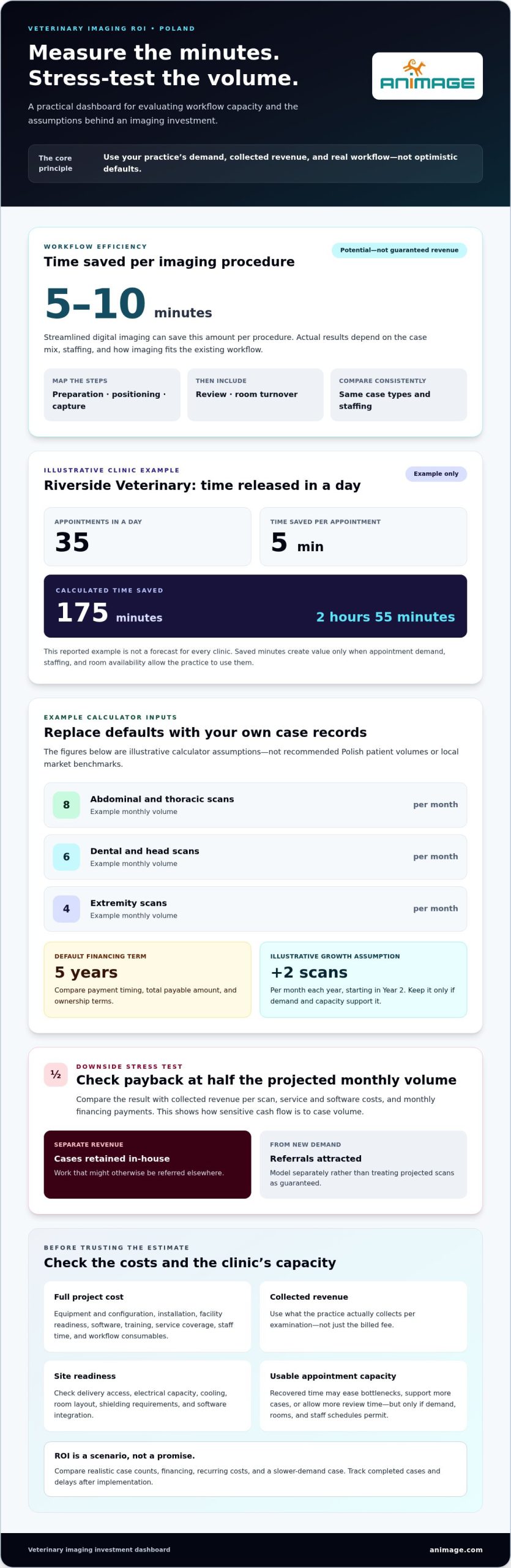
Workflow efficiency affects ROI through staff time and usable appointment capacity. Streamlined digital imaging can save 5-10 minutes per imaging procedure. To assess the effect, map patient preparation, positioning, image acquisition, review, and room turnover. Time each step separately. This shows where imaging reduces delays and where other tasks still limit throughput.
Riverside Veterinary reported seeing 35 appointments in a day and saving 5 minutes per appointment. Across those 35 appointments, that saving equals 175 minutes of staff time, or 2 hours and 55 minutes. Treat this as an example, not a forecast for every clinic. Local results depend on the appointment mix, staffing, and how imaging fits the existing workflow.
For a practical estimate, record imaging-related steps across a representative working day. Note which staff members prepare patients, capture images, and transfer them to the clinician. Then identify repeated tasks, such as moving a patient between rooms or waiting for images. Compare the existing process with the proposed setup using the same case types and staffing assumptions.
Saved minutes create value only when the clinic can put them to use. They may make room for more appointments, reduce bottlenecks, or give clinicians more time for case review. Match recovered time to appointment demand and room availability. A faster imaging step won’t increase daily capacity if consultation rooms, staff schedules, or patient handling remain the bottleneck.
Include workflow effects in the ROI estimate as a separate scenario, not as guaranteed revenue. Calculate time released per procedure, then compare it with the schedule’s actual gaps and demand for appointments. Track completed cases and delays after implementation. Reviewing an integrated veterinary imaging workflow can help frame how equipment configuration fits the clinic’s patient flow.
Interactive veterinary practice ROI estimation
A useful ROI estimate separates revenue, operating costs, financing, and capacity gains. Enter your Polish practice’s data instead of treating an online calculator’s preset values as local market benchmarks. The result should show cash flow and payback under multiple case-volume scenarios, not just one optimistic projection.
Start with monthly examinations by modality and the amount the practice actually collects per case. The example calculator assumptions include 8 abdominal and thoracic scans monthly, 6 dental and head scans, and 4 extremity scans. These are inputs for illustration, not recommended Polish patient volumes. Replace them with your own case records and expected referral demand.
Next, enter the equipment investment, financing term, and recurring costs in zł. The calculator’s default financing term is 5 years. It also models volume rising by 2 scans per month each year, starting in Year 2. Keep that growth assumption only if staffing, appointment availability, and referral patterns support it. Otherwise, use a flat-volume case.
Run a downside scenario as well. The example calculator presents payback at half the projected monthly volume. Compare that result with expected collections per scan, service and software costs, and monthly financing payments. This reveals which assumption has the greatest effect on cash flow. Separate revenue from procedures retained in-house from revenue generated by new demand.
Before relying on the output, check that each input reflects Polish billing and accounting conditions. The calculator’s 2026 reimbursement estimates use US Medicare Physician Fee Schedule averages, so they don’t represent Polish reimbursement. A structured veterinary imaging ROI estimate is most useful when every volume, charge, and cost field matches your clinic’s actual operating model.
Veterinary imaging revenue growth
Imaging can support revenue growth through examinations performed in-house, cases retained, and referrals received. iVET360’s 2026 benchmark report recorded veterinary diagnostic imaging revenue growth of 4.6%. Treat that benchmark as context, not a forecast for a Polish clinic. Local results depend on case mix, pricing, referral relationships, and whether available appointments can accommodate additional imaging.
Start with cases currently sent to specialist centres. Identify which could be assessed in-house using advanced imaging, including cone-beam CT or fluoroscopy. Estimate revenue retained from those cases separately from revenue from new demand. This distinction matters: bringing an existing case in-house changes where revenue is earned, while attracting additional cases may grow total practice activity.
Referral potential is another possible source of growth. Clinics with advanced imaging capabilities may attract cases from other practices. Map existing referral relationships, identify examinations those practices send elsewhere, and estimate which cases fit your clinical capacity. Then account for the staff time and appointment access needed to serve them. A referral opportunity creates no usable revenue if the workflow cannot accommodate it.
Owners’ understanding also influences the diagnostic conversation. Imaging that helps owners see findings can support their understanding of and trust in treatment recommendations. Connect this benefit to clear clinical communication, not an assumption that every recommendation will be accepted. Track completed imaging examinations, referral sources, and cases retained in-house. Review these measures alongside collected revenue to see whether growth comes from higher volume, a changed case mix, or increased referral activity.
For a disciplined growth assessment, compare current activity with a projected case mix and test a lower-volume scenario. Include capacity limits and the costs of running the imaging workflow. To assess an imaging platform against your clinic’s growth priorities, explore veterinary imaging options.
Animage: FIDEX+
Animage offers FIDEX+, an integrated veterinary imaging platform that combines cone-beam CT, digital radiography, and fluoroscopy in one compact device. Purpose-built for animals, it brings several imaging workflows together in a single system for veterinary clinics, referral hospitals, and research institutions.
Consider FIDEX+ when your ROI assessment points to in-house advanced imaging and your case mix calls for more than one modality. Compare the system with the examinations you expect to perform, the space available, and the workflow capacity needed to use it effectively. A multi-modality platform may suit practices looking to bring different imaging functions into one device rather than planning around separate systems.
Contact Animage to discuss how FIDEX+ can fit your practice’s imaging requirements.
Make the Next Decision With Practice Data
Use your ROI model as a decision tool, not as a target for justifying an equipment purchase. Assign responsibility for tracking completed scans, monitoring collections, and reviewing cases that could be retained or referred. Regular review keeps the model useful as demand and workflow change.
A veterinary imaging equipment ROI calculator for 2026 can help structure that assessment, but projected returns aren’t guaranteed. Treat each estimate as a working scenario, then refine it with your practice’s operating data. If your analysis points toward evaluating imaging equipment, connect the financial model to the system’s clinical and workflow fit before deciding.
Animage offers FIDEX+ for veterinary imaging. Contact Animage about your imaging ROI to discuss how the platform relates to your practice’s requirements. A measured assessment gives your team a clearer basis for the next step.
Frequently Asked Questions
How many studies does it take to pay off an imaging system?
There’s no single study count that applies to every imaging system. Calculate the break-even count by dividing the total investment by the net contribution from each completed examination. Net contribution means collected revenue after variable costs, not the billed charge. Separate scan types in your calculation: a dental examination and a complex CT study may have different charges, staff requirements, and collection outcomes.
Is the calculator free?
Will the Equipment Pay for Itself?
An investment pays back through operating contribution when revenue collected from imaging and retained cases exceeds the equipment’s total costs over time. Revenue alone doesn’t establish payback. Include routine expenses, financing, and the capacity to perform the projected examinations. If the system supports cases previously referred elsewhere, record them separately from genuinely additional demand to avoid counting the same growth twice.
How can a veterinary clinic calculate imaging equipment ROI, payback period, and break-even scan volume?
For a veterinary imaging equipment ROI calculator 2026, begin with total investment and expected net contribution per scan. ROI compares net financial gain with investment; payback period identifies when cumulative contribution covers that investment. Break-even scan volume divides fixed costs by contribution per scan. Use collected revenue after variable costs, and calculate each modality separately when exam economics differ.
What revenue and utilization assumptions should a veterinary imaging ROI calculator include?
Use completed scans by modality, collected amounts per examination, operating days, and realistic schedule capacity. Separate routine cases from referral examinations and procedures retained in-house. Include periods when equipment is unavailable, as well as times when trained staff or patient appointments limit use. Test a lower-volume scenario alongside the expected one, then compare cash flow and utilization.
What are the main risks and hidden costs when investing in veterinary imaging equipment?
Key risks include lower-than-planned scan volume, collections below billed charges, and limited staff or appointment capacity. Project costs may also include delivery, installation, shielding, electrical upgrades, cooling, software licensing, training, and service coverage. For a fixed cone-beam CT setup, room readiness can materially change the project scope. List each cost separately so equipment purchase terms don’t obscure the full investment.