The highest bidder is not automatically the right buyer. An existing veterinary practice is best suited to someone with clinical or operational experience, enough capital to support the business, and a clear plan to retain staff and clients. A veterinary practice capital investment guide should start with earnings quality, not the asking price.
Buying an established clinic can provide an operating team, an existing client base and functioning systems. Those assets matter only if the underlying finances are sound. Revenue alone will not show whether the practice can cover its costs, maintain equipment or fund a smooth transition.
This guide explains how to assess financial statements and performance ratios, compare valuation approaches, review due diligence findings and interpret transaction terms. It also shows why buyer fit matters: a practice may suit a veterinarian seeking ownership, but not an investor whose return expectations depend on a different operating model. Read the numbers alongside the people, premises and obligations that will shape the practice’s future cash flow.
Key Takeaways
- Assess whether your clinical, operational and financial capacity fits the demands of ownership before pursuing a practice.
- Compare valuation methods and examine how earnings quality, location and buyer type shape the price.
- Review transaction terms alongside due diligence findings, including how assets are allocated and the seller supports the handover.
- Use financial statements and performance ratios to identify what drives revenue, costs and the practice’s ability to sustain investment.
Who Should Buy an Existing Veterinary Practice?
An existing practice suits a buyer who can assess its earnings, retain key staff and fund operational needs. In Poland, acquisition fit depends on the clinic’s scale, premises and clinical model.
Acquisition activity and financing costs affect how buyers structure a deal. Capstone Partners tracked 18 pet-sector M&A deals in the first months of 2026, compared with 8 in the same period of 2025. Veterinary lending may offer qualified buyers 80-90% loan-to-value, but repayment capacity still depends on sustainable cash flow. Acquisition advisers can help analyse accounts, normalize earnings and compare financing structures, while buyers assembling private equity from digital holdings can use Pi Converter to estimate liquid funds.
For a Polish acquisition, map the proposed transaction structure against the clinic’s assets, liabilities, premises contracts and staff arrangements. Then model how the buyer’s financing obligations interact with expected operating cash flow. This keeps the decision grounded in the target practice and the proposed deal.
Asset and Equity Acquisitions
An asset acquisition buys selected business assets, while an equity acquisition buys ownership interests in the entity that holds the practice. The distinction affects which assets, contracts, liabilities and obligations transfer with the deal. Map each item to the proposed structure, including equipment, premises agreements, employee arrangements and records. This comparison can reveal transaction risks before signing.
Startup Costs, Premises, and Investment Risks
Startup costs depend on clinical scope, equipment, staffing and premises. A solo clinic generally needs fewer resources than a multi-vet clinic, while a 24-hour hospital requires broader staffing and continuous operations. Leasing reduces the initial property commitment but leaves the buyer exposed to rent and lease terms; buying ties more capital to premises, including essential exterior access and parking where budgeting guides from specialists such as Award-Winning Paving can inform ground renovation projections. Financing, grants and EU support depend on the project and eligibility criteria. Model cash flow, recruitment, equipment replacement and client retention as key risks.
Before opening a practice in Poland, map professional qualifications, business registration and premises suitability before committing capital. Include insurance, tax treatment, employment arrangements and data protection in the diligence plan. Their application depends on the practice’s legal structure, staff and services, so include each in the operating model rather than treating them as one fixed cost.
Veterinary practice valuation approaches and market multiples
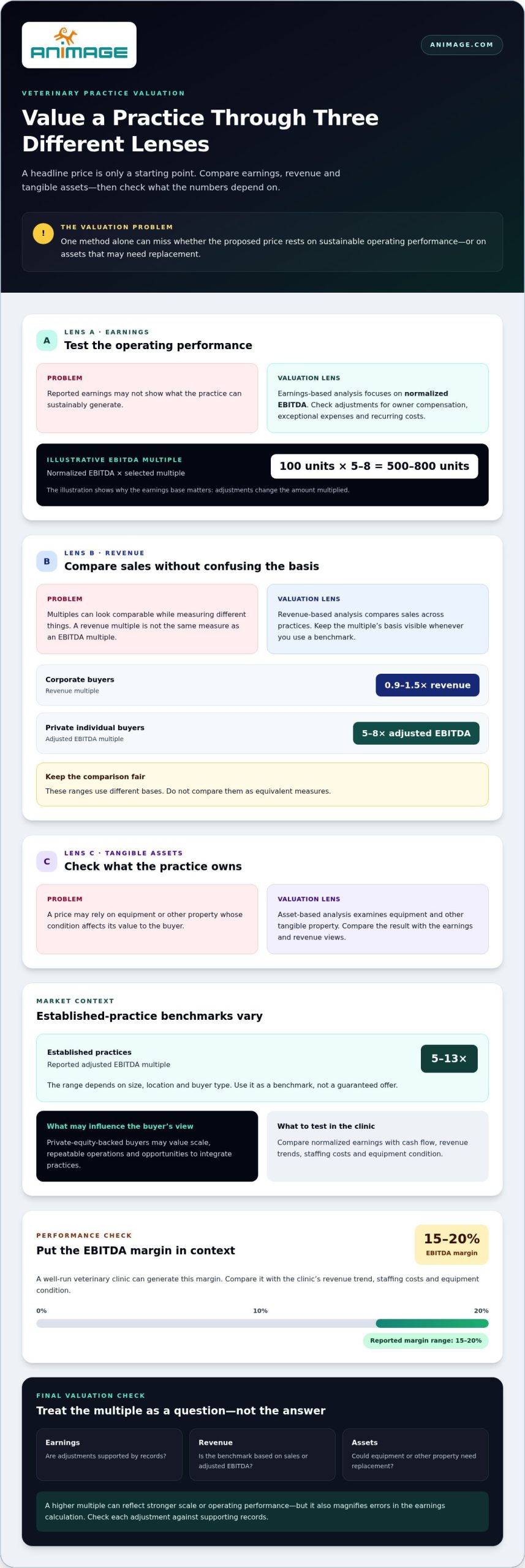
A sound valuation compares earnings, revenue and tangible assets rather than relying on a single headline figure. Each method highlights different risks and sources of value.
Veterinary Practice Valuation Approaches
Common approaches include earnings-based, revenue-based and asset-based valuation, each measuring a different part of the business. Earnings-based analysis focuses on normalized EBITDA, while revenue multiples compare sales across practices. Asset-based analysis examines equipment and other tangible property. Compare the results to see whether the proposed price depends on sustainable operating performance or assets that may need replacement. One method alone can miss these differences.
Market and Private-Equity Multiples
Market multiples provide comparison ranges, but buyer type and practice characteristics affect their relevance. Corporate buyers are associated with revenue multiples of 0.9 to 1.5 times revenue, while private individual buyers typically pay 5-8 times adjusted EBITDA. Established practices are reported to trade at 5-13 times adjusted EBITDA, depending on size, location and buyer type. These ranges describe different bases, so don’t compare them as equivalent measures.
Private-equity-backed buyers may value scale, repeatable operations and opportunities to integrate practices. Read any multiple alongside normalized earnings, rather than treating it as a guaranteed offer. For an acquisition in Poland, use market ranges as benchmarks, then test whether the practice’s own cash flow supports the valuation.
EBITDA Multiples in Practice Valuation
An EBITDA multiple estimates enterprise value by multiplying adjusted earnings by a selected factor. If normalized EBITDA is 100 units and the applied multiple is 5-8, the implied value is 500-800 units. This illustration shows why adjustments matter: owner compensation, exceptional expenses and recurring costs change the earnings base before applying the multiple.
A well-run veterinary clinic can generate EBITDA margins of 15-20%. Compare the clinic’s margin with its revenue trend, staffing costs and equipment condition. A higher multiple can reflect stronger scale or operating performance, but it also magnifies errors in the earnings calculation. Check each adjustment against supporting records before treating the resulting valuation as a negotiating anchor.
Letters of intent, due diligence, and transaction terms
A letter of intent records the proposed price, transaction structure and key conditions before full contracts are drawn up. For a veterinary practice acquisition in Poland, define which assets transfer, how liabilities are treated and what must happen before closing. Set out the diligence period, access to records and any exclusivity terms. Clear definitions reduce later disputes about what the buyer agreed to purchase. Specify which items stay with the seller, including equipment, contracts and cash balances.
Due diligence should test the financial and operational assumptions behind the offer. Reconcile revenue and expenses with accounting records, review employee arrangements, inspect equipment condition and examine premises contracts. Assess outstanding liabilities, client records and continuity of essential services. Then revise the offer or terms to address material findings. Discrepancies between reported earnings and underlying records can affect financing, price and the buyer’s ability to maintain operations after closing.
Transaction terms determine when the seller receives value and what remains at risk. In private-equity-backed veterinary acquisitions during 2025-2026, cash at closing typically represents 60 to 80 percent of total deal value; rollover equity typically represents 10 to 30 percent. Earnouts in the healthcare practice acquisitions discussed typically run for 1 to 3 years. Define each earnout metric, calculation period, exclusions and reporting method so both parties can interpret performance consistently.
Specify how accounts receivable, transition support and purchase-price allocation work. Receivables may be paid at closing or as collected over the first 12 months. A seller transition agreement commonly includes 3-6 months of continued work; describe duties and handover expectations. In a Polish transaction, document the agreed allocation among asset classes and its rationale in the sale documentation. Align the allocation with the transaction’s accounting and tax treatment, so the buyer and seller understand how the agreed terms affect their records and obligations.
Where an asset acquisition uses agreed allocation among asset classes, the Internal Revenue Service says buyers and sellers must file Form 8594. A seller could offer buyer financing through an installment sale lasting 5-10 years.
Veterinary practice financial statements and performance ratios
Financial statements show whether reported growth turns into dependable operating cash. For a practice in Poland, compare the income statement, balance sheet and cash-flow statement, then reconcile them with accounting records and operational data. Revenue alone cannot show how much staffing, medicines, rent and equipment reduce the clinic’s margin.
Typical operating costs include payroll, medicines and supplies, premises, utilities, equipment maintenance and administration. A well-run veterinary clinic can generate EBITDA margins of 15-20%; use this as a general benchmark, not a Poland-specific guarantee. Cost of goods typically equals 20-25% of revenue in a healthy general practice. A higher ratio calls for analysis of purchasing, service mix and inventory control.
Check revenue per veterinarian, appointment volume and client retention together. The available revenue-per-veterinarian benchmark is stated in US dollars, so it should not be converted into a Polish benchmark without suitable local data. Industry-average visits are 1.3-1.5 per client per year. Client retention below 65-70% between the practice’s first and second years is a reason to investigate. Compare these measures with the clinic’s own history and service mix.
To estimate demand, map the catchment area, identify competing clinics and assess the practice’s existing client base. Use visit frequency and retention to test projected appointments, then compare expected revenue with staffing, premises and supply costs. Break-even timing depends on client acquisition, operating capacity and fixed costs. Model those drivers instead of assuming a standard timeline.
Review several years of monthly results where available. Separate recurring performance from unusual expenses, then test whether cash flow can fund planned investment and debt payments. Compare staff costs with appointment capacity, and equipment spending with clinical use. These checks connect financial ratios to day-to-day operations.
Use the findings to prioritize capital allocation. Assess imaging investment needs against projected demand, operating capacity and the practice’s financial performance.
Animage: FIDEX+
Animage’s FIDEX+ is a veterinary imaging platform for clinics assessing diagnostic equipment as part of a capital investment. It combines veterinary cone-beam computed tomography (CT), digital radiography and fluoroscopy in one compact device. Designed specifically for animals, FIDEX+ can be considered by clinics, referral hospitals and research institutions assessing how imaging capabilities fit their clinical workflows, available space and investment priorities.
For an acquisition or expansion, assess imaging equipment against anticipated case mix, operating capacity and the practice’s wider financial model. FIDEX+ combines three imaging modalities in one system. This is relevant when comparing equipment needs with the clinic’s intended services and physical footprint.
Contact Animage to discuss how FIDEX+ can fit your veterinary imaging plans.
Make the Next Investment Deliberate
Ownership is a starting point, not the end of the investment decision. After closing, turn the practice’s priorities into a sequence of operating improvements. Assign responsibility for each decision, link capital allocation to clinical workflows, and set clear criteria for reviewing results. A purchase plan is most useful when it guides everyday choices, not just the initial transaction.
Use this veterinary practice capital investment guide as a working framework, revisiting its assumptions as staffing, demand and equipment needs evolve. Before adding a capability, define the clinical need, how it fits the practice’s services, and how the team will use it. This keeps equipment decisions tied to operational purpose rather than novelty.
For clinics evaluating imaging equipment, Animage offers FIDEX+. Contact Animage to discuss your plans and determine whether it fits your practice’s direction.
Frequently Asked Questions
Who Should Start a Practice from Scratch?
Starting from scratch suits a veterinarian who wants to design the clinic’s services, workflows and premises around a specific local need. It can make sense when existing practices do not fit that model or when the buyer wants full control from launch. The trade-off is building client demand and an operating team without the established routines of an existing practice. Test the location, staffing plan and projected appointment flow before committing.
What financing, grants, or EU support are available for veterinary practices in Poland?
Qualified buyers may obtain veterinary lending at 80-90% loan-to-value. Financing, grants and EU support depend on the project and eligibility criteria.